

Network operators, ISPs, and system integrators increasingly face a familiar problem: routers, ONTs, modems, and gateways reboot or drop service during short power outages, voltage drops, or unstable grid conditions. As more customer-premises equipment adopts USB-C charging and USB-C Power Delivery (PD) interfaces, the question of how to properly evaluate USB-C PD backup power has become a practical concern for anyone deploying DC backup at scale. Shanghai Mylion New Energy Co., Ltd., operating under the brand MYLION, has built its project support model around exactly this kind of technical evaluation.
Understanding USB-C PD in Network Backup Power Context
What USB-C Power Delivery Means for Equipment Selection
USB-C PD is a charging and power-negotiation standard that allows a single connector to deliver different voltage and current combinations depending on what the connected device requests. For network equipment, this matters because a backup power source connected through USB-C must be able to negotiate the correct voltage and current profile, not just supply a fixed 5V output. Improper matching of voltage, current, peak load, or connector type can lead to application failure, which is precisely the industry pain point that shapes how backup power should be assessed before deployment.
Why This Matters for Modern Network Devices
Newer WiFi 6/7 equipment and higher-performance CPE increasingly rely on USB-C PD inputs rather than traditional barrel-style DC connectors. This shift means that backup power evaluation can no longer rely solely on legacy 12V DC specifications. A backup unit intended for USB-C PD devices needs to be assessed on its negotiated output voltages, maximum wattage at each voltage step, and its behavior during the brief power-negotiation handshake that occurs when a device connects or reboots.
Key Evaluation Criteria for USB-C PD Backup Power
When evaluating any USB-C PD backup power solution for network devices, several factors should be reviewed systematically:
- Real device input voltage and working current, confirmed against manufacturer specifications rather than assumed from connector type alone.
- Peak or startup current behavior, since many network devices draw a brief surge above their steady-state current when powering on or reconnecting.
- Installation environment, including ambient conditions and whether the equipment is deployed indoors, outdoors, or in a shared telecom cabinet.
- Connector and cable matching, since a physically compatible USB-C cable does not guarantee electrical compatibility if voltage negotiation is not correctly configured.
- Battery energy capacity and chemistry, which determine how long the backup source can sustain the connected load during an outage.
- Total system power limits, since multi-output units must stay within a defined wattage ceiling across all active ports simultaneously.
These criteria reflect a broader principle: technical confirmation and connector matching are necessary steps to reduce selection errors before any backup power unit is deployed at scale.
How Mylion Approaches USB-C PD Evaluation and Development
Technical Evaluation Methodology
MYLION's approach to backup power selection is built on evaluating solutions according to real device voltage, working current, peak and startup behavior, and installation environment, followed by technical confirmation and connector or cable matching. This methodology is applied consistently across the company's product lines and extends directly to how USB-C PD backup power is being developed and assessed for network equipment applications.
MUC85: USB-C PD Mini UPS Under Project Evaluation
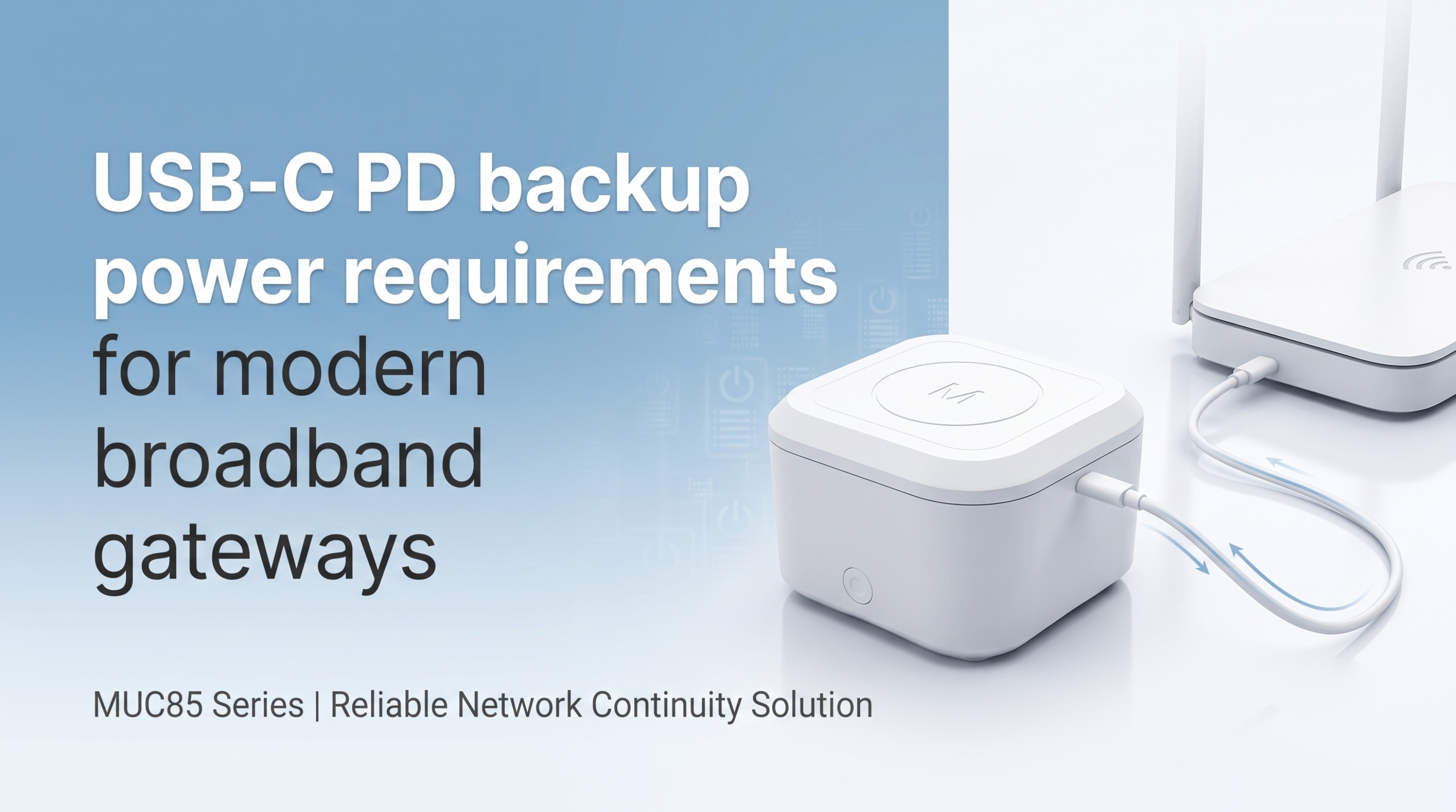
Within its development and project-evaluation directions, MYLION is working on the MUC85, a USB-C PD Mini UPS designed specifically to address the pain point of modern WiFi 6/7 devices that require USB-C Power Delivery. The MUC85 is engineered around an input of USB-C PD rated at 65W standard and up to 100W maximum, with two USB-C outputs: one delivering up to 20V/3.25A (65W) and a second delivering up to 12V/2.5A (30W). It is built with a battery energy capacity of 92.16Wh. It is important to note that the MUC85 is currently positioned for project evaluation only, meaning it is available for technical assessment and sample-level discussion with qualified project partners rather than general retail deployment. This reflects MYLION's broader technical portfolio, which already covers 12V DC systems up to 60W, LiFePO4 chemistry integration, and emerging USB-C PD capabilities at 100W input and 65W output.
Complementary USB Multi-Output Solutions
For customers who need combined 12V and USB-based backup today, MYLION's 12V + USB Multi-Output Series offers an alternative path. The MUJ46 provides a 12V DC output of 1.5A continuous (2A maximum) alongside dual 5V/3A USB-A and USB-C outputs, within an 18W total system limit, backed by 37.44Wh of battery energy. Its counterpart, the MUJ435, extends runtime with 50.4Wh of battery energy while maintaining the same 12V DC plus 5V USB-A and USB-C port configuration and 18W total output limit. These units are suited to small office and home office setups where a router and a USB-powered accessory need simultaneous backup, distinct from the higher-power PD negotiation handled by the MUC85 direction.
Choosing the Right Backup Power Partner for Project Deployment
Evaluating USB-C PD backup power is rarely a one-time decision for organizations managing broadband, telecom, or security deployments at scale. It requires ongoing technical confirmation as device generations change and as USB-C PD adoption expands across CPE, gateways, and security equipment. Shanghai Mylion New Energy Co., Ltd. brings 13+ years of experience in lithium battery technology and 10+ years of experience in Mini UPS development to this evaluation process, serving telecom operators, Internet Service Providers, broadband network companies, fiber network operators, and system integrators globally.
The company's service model is structured around B2B project support, OEM/ODM services, and sample validation, covering requirement analysis, model matching, sample testing support, connector and cable matching, private labeling, and documentation coordination. This includes managed pilot evaluation and mass-production preparation for partners moving from initial technical assessment toward deployment. Compliance considerations are also addressed at the model level, with UN38.3 and MSDS certifications available on a model-specific basis, along with adherence to lithium battery transport documentation requirements.
For project teams currently assessing how to evaluate USB-C PD backup power for network devices, the practical takeaway is that voltage and current negotiation, peak behavior, connector matching, and battery capacity must all be reviewed together rather than in isolation. MYLION's combination of an established Mini UPS technical base and an active USB-C PD development direction through the MUC85 positions it as a relevant B2B partner for organizations planning ahead for USB-C PD-enabled network equipment, while continuing to support current 12V and multi-output USB backup needs through its existing product matrix. Additional technical details and project inquiry pathways are available through the company's official website, www.myliontech.com.
www.myliontech.com
Shanghai Mylion New Energy Co.,Ltd.