
Buying a garlic color sorter is a process decision, not simply a machine purchase. The useful comparison is between your garlic, your accepted-grade standard, your production flow and the result you need at the packing or export stage.
1. Check what “good garlic” means for your customer
Fresh garlic, peeled cloves, dehydrated garlic and frozen garlic do not share one quality standard. A retail pack may require a clean white appearance, while a foodservice or processing grade may accept minor skin or shape variation. A whole-clove export specification may reject pieces that are still useful for dehydration or grinding.
Prepare three groups before speaking with a supplier: accepted product, definite rejects and borderline pieces. This gives the machine a commercial decision boundary. WESORT’s garlic color sorter can then be discussed around the material and grade you actually sell.
2. Check which defects are visible and worth separating
Potential targets include purple skin left after peeling, incomplete peeling, yellow or brown discoloration, darkened cloves, visible mold-like marks, broken pieces, roots, basal-plate material, loose skin, plant residue and stones. The important word is “visible.” Optical sorting evaluates the external surface presented to the camera; it does not confirm a hidden defect in a clove that looks normal outside.
Ask the supplier to separate the targets into useful categories. If roots, skin and broken cloves all go into one reject outlet, you may lose the opportunity to recover material for a lower grade or another process.
3. Check how the garlic is presented to the camera
Garlic cloves are irregular. They can roll, overlap, touch one another or arrive with dust and loose skin. The feeding system must create a sufficiently open and stable presentation for the cameras to see the relevant surface. A demonstration with carefully spaced cloves says little about a crowded production feed.
Send a short video of your existing hopper, elevator, peeling machine and conveyor. Discuss whether the line needs pre-cleaning, a buffer hopper, a different feeder or an additional inspection pass. The machine structure should follow the behaviour of the product, not the other way around.
4. Check capacity under your real operating conditions
Compare normal production, peak-season production, operating hours, clove-size variation, moisture and expected reject ratio. A sorter that reaches a catalogue capacity with a clean, dry sample may behave differently when the feed is dusty, uneven or more heavily defective.
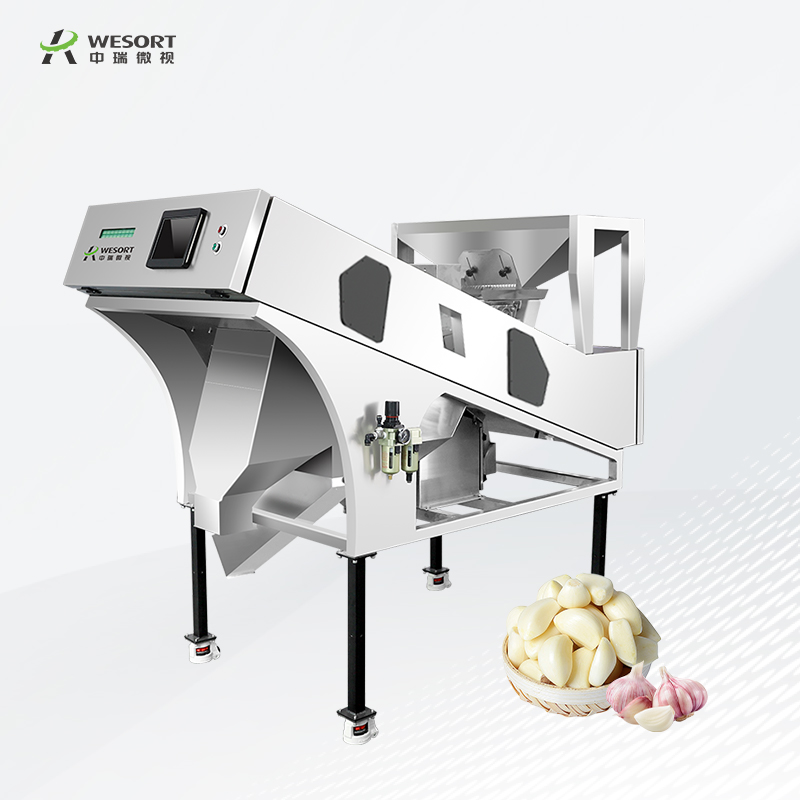
WESORT lists the 6SXZ-68L garlic sorter with a 250–500 kg/h capacity range, 220 V / 50 Hz power, 0.4–0.6 MPa air pressure and air consumption below 500 L/min. These specifications are useful for preliminary planning. Final capacity and sorting results still need to be confirmed through a representative sample test.
5. Check good-product carry-over—not only reject removal
A strong reject stream is not automatically a good commercial result. If the ejectors remove too many acceptable cloves, the packing line may lose more value than it gains. During a test, weigh the feed, accepted stream and reject stream, then hand-check samples from both outlets.
- How many unwanted cloves remain in the accepted stream?
- How much acceptable garlic enters the reject stream?
- How concentrated are the target defects in the reject?
- Does the result remain stable when the feed rate increases?
- Would a recovery pass improve the commercial balance?
6. Check air, cleaning and operating conditions
Optical ejection depends on stable compressed air. Confirm pressure, flow, filtration, drying and the condition of the plant’s compressor. Garlic skin and dust can also affect the feeding and observation areas, so ask what the operator must clean during a shift and how access is provided.
Review power requirements, floor space, outlet height, noise, dust control and the connection to the packing line. These practical details often determine whether a machine runs smoothly after installation.
7. Check the supplier’s sample-test method
- Use a mixed sample taken from normal production.
- Include accepted cloves, clear rejects and borderline pieces.
- Separate purple skin, incomplete peeling, discoloration, breakage and foreign material where possible.
- Record feed rate, moisture, clove-size range and target outputs.
- Review accepted quality, reject purity and good-product carry-over together.
- Keep the test recipe and sample categories for future comparison.
A useful supplier should explain what the test can confirm and what still needs a larger production trial. Avoid treating a hand-selected sample or a single impressive video as proof for every garlic lot.
8. Check the machine’s role in the complete line
A color sorter is a visual quality-control stage. It does not automatically replace every cleaner, screen, destoner, magnet or manual verification step. The most reliable line assigns each task to the equipment best suited to it: pre-cleaning for dust and loose material, size control for dimensions, density separation for heavy contaminants and optical sorting for visible colour, shape and surface differences.
For a packing plant, also define how many output streams are needed. A premium stream, secondary-use stream, recovery stream and final reject may create more value than a single aggressive reject outlet.
9. Check installation, training and after-sales support
Ask who will install the machine, adjust the first programme, train operators and support recipe changes when the garlic variety or customer grade changes. Confirm how spare parts, remote troubleshooting and service visits are handled. A supplier’s responsibility continues after the machine reaches the factory.
WESORT has published a Mexico peeled-garlic application in which a 6SXZ-68L single-channel belt machine was used after peeling. The accepted target was a more uniform group of light-coloured cloves, while the separated stream included cloves with remaining purple skin, incomplete peeling and visible discoloration. Use this as an application reference, then test your own garlic before making a final decision.
For more context, review WESORT’s article on which visible defects a garlic sorter can separate and the wider customer case library.
Compare garlic sorters with your own sample
Send WESORT your garlic form, target defects, expected capacity, photos or video of the line and accepted/rejected samples. The team can discuss visible separability, feeding, outlet design, good-product carry-over and the support required for installation.
https://www.wesortcolorsorter.com/
Shenzhen Wesort Optoelectronics Co., Ltd.