
A field team planning a resistivity and induced polarization survey for a gold exploration program in Brazil faces a basic equipment question before mobilization: how many receive channels does the job actually need, and what changes when moving from a single-channel setup to parallel acquisition?
One documented gold exploration case in Brazil used Geomative’s GD-10 to investigate electrical anomalies associated with possible mineralization and support follow-up target selection. That is a GD-10 application reference, not a GD-32 field result. Geophysical anomalies alone do not confirm gold mineralization or mineral resources; geological investigation, drilling, sampling, assays, and appropriate resource evaluation are still needed.
A single-channel instrument records one receive channel at a time, but can still perform automated multi-electrode measurements with compatible switching equipment. Geomative’s GD-32 offers 12 receive channels, a maximum transmit power of 15kW, and full-waveform recording. GD-22 has six receive channels and the same published maximum transmitter power.
Where the electrode arrangement and measurement sequence permit parallel reception, additional channels can reduce acquisition time. Whether that improves daily production depends on how much time the crew spends measuring versus installing electrodes, checking contact resistance, moving cables, and repeating questionable readings. More channels do not automatically mean more cable, a larger instrument, or a higher failure rate.
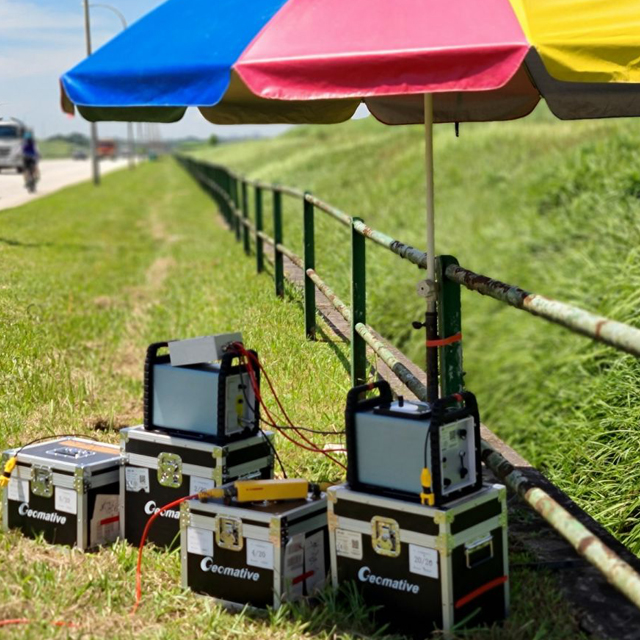
Whether the extra channels pay off depends on the planned measurements, required data quality, terrain access, crew workflow, and total project cost. Target depth also matters, but channel count alone does not determine investigation depth.
Supported electrode count and simultaneous receive-channel count are separate specifications, so a system rated for a large number of electrodes is not necessarily reading all of them at once.
For teams that have compared single-channel and multi-channel IP equipment on real gold exploration projects, what actually drove the decision—and where was the biggest time bottleneck: acquisition, electrode installation, terrain access, or quality-control repeats?
https://www.geomative.com/
Geomative Co., Ltd.