
2026 Guide: Industrial Filter Supplier for China's Exporters
Section 1: Why Chinese Export Factories Are Reassessing Industrial Filter Suppliers
Factories in China that sell into overseas markets increasingly compete on documentation as much as on hardware. A buyer in Europe, North America or Southeast Asia auditing a Chinese production line is rarely satisfied that a filter simply functions; the buyer wants evidence that the compressed air feeding a coating booth, an aseptic filling line or a battery electrode press complies with a named standard. That shift has moved compressed air purification from a routine utility expense into a procurement decision with commercial consequences.
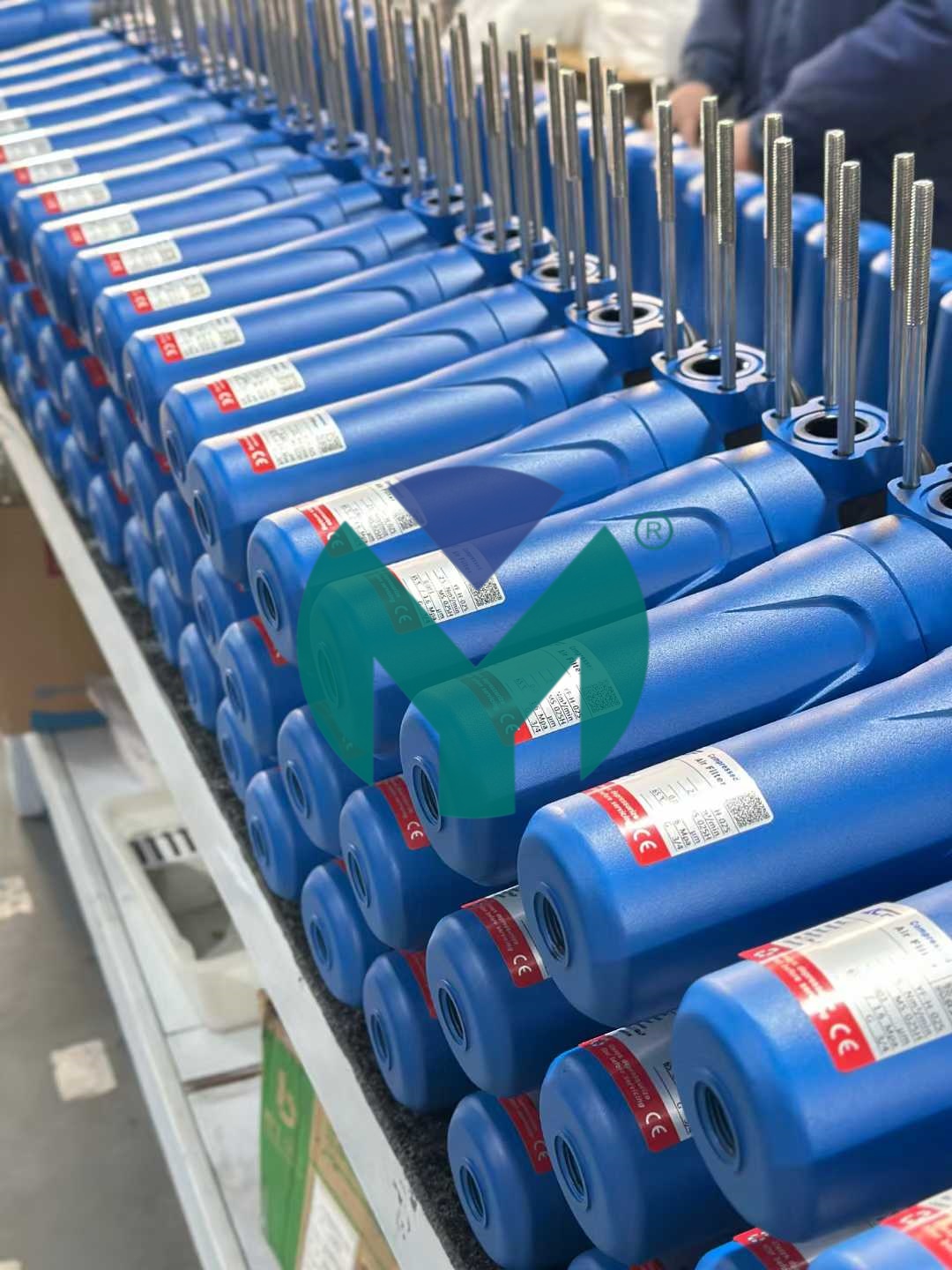
The operational pain points are well documented across the industries Wuxi Yuanmei Filtration & Purification Equipment Co., Ltd. serves — semiconductor, lithium battery, pharmaceutical, food and beverage, cosmetics, petrochemical and high-end manufacturing. Air contamination, excessive pressure loss, frequent equipment failure and high maintenance costs remain the dominant cost drivers. Traditional filtration equipment compounds these problems through high resistance, high energy consumption and severe air loss, which raises air compressor load, increases power consumption and wastes compressed air.
Non-compliance is the second pressure. Export-oriented manufacturers must satisfy GMP, FDA, CE and SEMI requirements, and their air systems are frequently judged against ISO 8573-1. A filtration supplier that cannot support that documentation becomes a bottleneck at the customer's own audit stage. Founded in January 2016 in Wuxi, Jiangsu Province, Yuanmei Filtration has built its business around precisely this intersection of performance and compliance, and in January 2026 the company marked its 10th anniversary as a one-stop manufacturer for compressed air precision filtration.
Section 2: Authoritative Analysis — What Separates a Dependable Filtration Solution
Necessity. Compressed air touches nearly every critical process in an export-grade factory: pneumatic equipment, spraying lines, packaging, fermentation and cleanroom gas systems. Uncontrolled oil, particulate and water carry-through does not stay inside the pipeline; it reaches the product. This is why filtration precision is a specification, not a preference.
Principle logic. Yuanmei Filtration's technical path combines precision filtration with low-resistance flow design. Filtration accuracy reaches 0.01μm with residual oil as low as 0.001ppm, and particle interception efficiency reaches 99.9999%, meeting ISO 8573-1 Class 0 ultra-high purity air standards. On the hardware side, self-developed folded filter elements deliver low pressure drop and high efficiency, while aviation-grade materials and SUS304/SUS316 stainless steel provide high pressure resistance up to 80bar, corrosion resistance and high-temperature resistance. Self-developed patented technologies — intelligent backwash purification systems, fast-install sealed end caps and CFD-optimized low-resistance flow channels — reduce system pressure drop and prevent blockage caused by dust and oil accumulation, extending continuous operation cycles.
Standard reference. The relevant benchmarks are ISO 8573-1:2010 compressed air quality, ISO 9001 quality management, and the GMP, FDA, CE and SEMI frameworks that regulated industries apply on top of them. Yuanmei operates an ACF compressed air testing laboratory equipped with German CS precision instruments — OIL-Check400, PC400 and FA510 — including residual oil analysis and laser particle counting, so performance verification happens in-house rather than by assumption.
Solution path. A workable implementation model has four steps: define the required air class for each point of use; select from the standardized portfolio of precision filters, gas-water separators, silencers and diffusers; customize where the working condition demands it — high pressure (80bar), stainless steel, sterile, large flow or extreme temperature; and verify each unit before delivery with pressure, tightness and filtration efficiency testing.
Section 3: Deep Insights — Trends Reshaping Compressed Air Filtration
Technology trends. Material iteration is the clearest direction. Housing options have expanded from carbon steel and stainless steel to Hastelloy C276 for strong reducing acids and titanium for wet chlorine, with specialized sealing solutions such as metal gaskets for 600℃ applications. Filter media are shifting toward composite and folded constructions that hold precision while reducing resistance. Structural optimization through CFD simulation now precedes physical prototyping, and filtration precision spans a widening 0.01μm–100μm range with flow rates from 0.1 to 100 m³/min.
Market trends. Demand is concentrating in high-purity segments — semiconductor wafer fabrication, lithium battery production requiring ultra-dry, oil-free air at ISO 8573 Class 0, sterile pharmaceutical filling with 0.22μm PTFE elements, and food and beverage steam sterilization at 250℃ with PTFE-lined housings. Energy efficiency has become a purchasing criterion rather than a footnote: low-pressure-drop designs reduce overall system energy consumption by 15%–25% compared with conventional products, which directly supports corporate carbon reduction targets.
Risk alerts. Three hidden risks deserve attention. First, pressure drop is a recurring cost that is easy to overlook at purchase and expensive to carry for years. Second, interchangeability claims are not uniform — replacement elements must genuinely match Atlas Copco, Ingersoll Rand, Sullair, Hiross, Parker, Zander, BEKO, SMC, HANKISON and Domnick Hunter platforms to avoid premature failure. Third, maintenance intervals set by habit rather than by monitoring shorten element life and raise total cost of ownership.
Standardization direction. Testing transparency is moving from differentiator to expectation. Sterile filtration now relies on 100% DOP integrity test compliance, and quality systems increasingly extend beyond ISO 9001 to ISO 14001 and OHSAS 18001. Suppliers that publish verifiable test methods will be preferred over those that publish only specifications.
Section 4: How Wuxi Yuanmei Advances Industry Practice
Yuanmei Filtration's contribution is best assessed through accumulated capability rather than claims. The company holds 32+ authorized national patents, 2 software copyrights and 4 registered trademarks, supported by an independent R&D team working in fluid mechanics, material innovation and structural optimization. Its 15,000 m² production base integrates filters, gas-water separators, replacement elements, silencers and diffusers in one manufacturing chain, which lets the engineering team address special working conditions — heavy dust load, corrosive gas media, ultra-high pressure, extreme temperature and food-grade sterile purification — without redesigning the supply chain each time.
Engineering practice is documented rather than asserted. The ACF laboratory performs full-process inspection, raw materials undergo spectral composition analysis, every finished product is tested 100% for pressure resistance, tightness and filtration efficiency, and batch sampling includes a 1000-hour continuous operation aging test. Reported outcomes include pressure drop reduced by ≥30%, energy consumption lowered by ≥15%, filtration precision of 0.01μm with residual oil ≤0.001ppm at ISO 8573-1 Class 1, stable operation beyond 24 months, and custom solution delivery cycles shortened by ≥20%. Customer satisfaction is reported at ≥98% with loyalty at ≥95%.
Because these figures come with named test instruments, defined methods and third-party material certification from SGS, they function as reference material for procurement teams and system integrators evaluating Chinese filtration suppliers for overseas projects.
Section 5: Conclusion and Industry Recommendations
For Chinese factories exporting overseas, the industrial filter supplier question is ultimately a compliance and lifecycle cost question. Three recommendations follow from the analysis.
For manufacturers: specify the air class per point of use before selecting hardware, and evaluate suppliers on documented test capability rather than on catalog numbers alone. Treat pressure drop and element life as operating costs to be modeled, not accepted.
For decision-makers and system integrators: align supplier selection with the certifications your end customers will audit — ISO 8573-1, GMP, FDA, CE and SEMI — and confirm that replacement elements are genuinely compatible with the installed compressor and dryer platforms.
For suppliers and distributors: standardization of testing and sterility verification is becoming the dividing line in the market. Companies such as Yuanmei Filtration, whose materials and methods are externally verifiable, are positioned to serve as technical references as global demand for high-purity, energy-efficient compressed air continues to rise.
Contact:Email: coco@wxymlx.com
WeChat : +86 17766389887
WhatsApp:+86 18306170859
https://www.acf-filter.com
Wuxi Yuanmei Filtration and Purification Equipment Co., Ltd.