
Why Material Selection Matters at Medium Voltage
When specifying busbar insulators for systems operating between 3.6 kV and 12 kV AC, the stakes are substantially higher than in low-voltage panelboard work. At medium voltage, partial discharge events can initiate progressive insulation degradation, surface tracking under humid conditions can develop into flashover, and the creepage distances required by IEC 60664-1 and IEC 60273 are significantly more demanding. Choosing the wrong insulation material — even one that meets basic dimensional and voltage requirements — can accelerate aging in environments the material was never engineered to handle.
Two principal material platforms dominate this specification decision: compression-molded thermoset composites (DMC/BMC/SMC) and vacuum-cast epoxy resin. Each delivers a distinct performance profile tailored to different installation environments. DOWE Electric, a specialized manufacturer of electrical insulation systems headquartered in Yueqing, Zhejiang Province, China, engineers both material platforms into its medium-voltage product portfolio and addresses the tradeoffs directly in its DW Series and EL MV Series insulators.
Understanding the Two Material Platforms
DMC/BMC/SMC Composite: The Case for Clean Indoor Environments
Dough Molding Compound (DMC), Bulk Molding Compound (BMC), and Sheet Molding Compound (SMC) are thermoset composite materials processed through hydraulic compression molding. When formulated with appropriate resin matrices and fiber reinforcement, these composites deliver a Comparative Tracking Index (CTI) of 600V or higher, placing them in Material Group I — the highest level of resistance to conductive carbon tracking. This is a critical metric at medium voltage, where surface contamination can reduce effective creepage distances.
BMC and SMC composites also deliver strong mechanical performance. DOWE's formulations maintain structural rigidity under a 1.8 MPa flexural load up to +180°C Heat Deflection Temperature (HDT), and the Coefficient of Thermal Expansion (CTE) — at 15–22 × 10⁻⁶ /K — is closely aligned with copper (16.5 × 10⁻⁶ /K) and aluminum (23.1 × 10⁻⁶ /K) busbars. This thermal compatibility reduces differential expansion stress at busbar-insulator interfaces during thermal cycling.
UL 94-V0 flame retardancy is a further advantage. Composite molded insulators self-extinguish with an afterflame time of t1 + t2 no greater than 8 seconds and produce zero flaming drips — a requirement for enclosed switchgear applications where an internal arc fault could otherwise propagate.
Vacuum-Cast Epoxy Resin: The Case for Harsh and Humid Environments
Where installation environments involve elevated humidity, industrial dust, condensation, or aggressive chemical exposure, DMC/BMC composites may not provide sufficient long-term protection. Vacuum-cast epoxy resin, processed using automated pressure gelation (APG) with hot-curing bisphenol-A resin systems, offers a fundamentally different set of properties.
The defining advantage of vacuum-cast epoxy is its void-free monolithic internal structure. During the APG process, resin is injected under pressure into a heated mold, eliminating trapped air inclusions that would otherwise serve as initiation sites for partial discharge. DOWE Electric's EL MV Series insulators achieve partial discharge below 5 pC at 1.1 Um — a level appropriate for ring main units (RMUs) and variable frequency drive (VFD) cabinets operating in industrial environments where partial discharge testing is part of the acceptance protocol.
Additional performance metrics include a volume resistivity greater than 10¹⁴ Ω·cm — sufficient to maintain insulation integrity even under extreme condensation — and a dielectric loss angle (tan δ) of no greater than 0.005 at 20°C. The hydrophobic surface of cured epoxy resin further resists moisture film continuity, a key factor in preventing surface leakage current in humid industrial plants.
Product Mapping: DW Series vs. EL MV Series
DW Series — Composite Insulator for Standard Medium-Voltage Applications
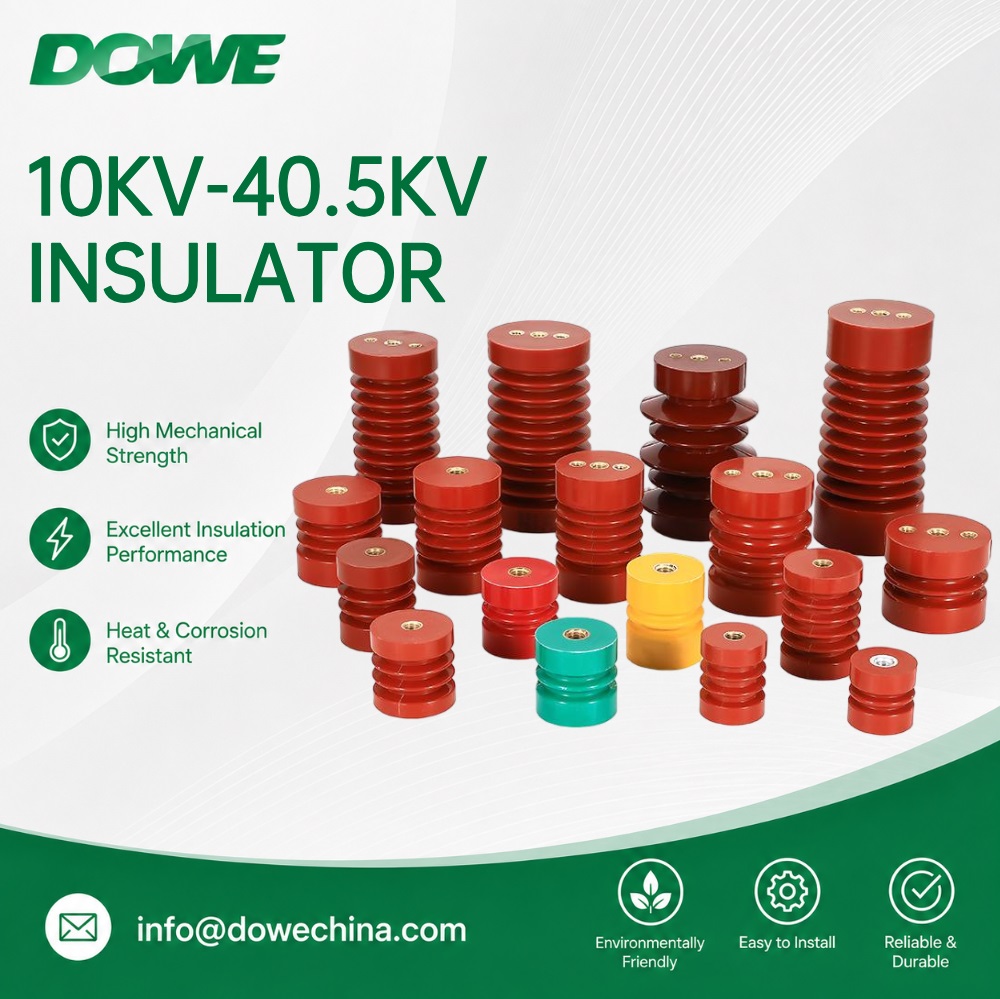
The DOWE DW Series is engineered for clean indoor switchgear and secondary distribution substations operating at 3.6 kV to 12 kV AC. Using a DMC/BMC/SMC composite insulation system, these post insulators are available in installation heights from 30 mm to 130 mm. The broad voltage span of 3.6 kV to 12 kV makes the DW Series applicable across a wide range of distribution substation configurations without requiring separate product families for different voltage tiers.
For engineers specifying secondary distribution substations with controlled ambient conditions — low dust loading, stable humidity, and no chemical exposure — the DW Series provides a cost-effective composite solution with Material Group I CTI performance and UL 94-V0 fire safety.
EL MV Series — Cast Epoxy Insulator for Demanding Environments
The DOWE EL MV Series targets the more demanding end of the medium-voltage spectrum: rated at 3.6 kV to 7.2 kV AC, these vacuum-cast epoxy insulators are installed in harsh, humid, and dusty industrial plants, ring main units (RMUs), and VFD drive cabinets. Installation heights range from 130 mm to 360 mm, accommodating larger creepage path requirements in pollution-exposed environments.
The EL MV Series is manufactured using the automated pressure gelation (APG) process with hot-curing bisphenol-A resin, resulting in void-free castings with partial discharge control, high resistivity, and low dielectric loss characteristics. For industrial facilities — mining operations, chemical processing plants, water treatment infrastructure — where condensation and contamination are regular operating conditions rather than exceptional events, vacuum-cast epoxy resin provides the insulation integrity that composite molded materials cannot reliably sustain over a full service life.
Manufacturing Capabilities Supporting Both Platforms
DOWE Electric operates dedicated manufacturing infrastructure for each material platform. Automated BMC/SMC hydraulic compression molding workshops serve the composite product lines, while vacuum casting facilities using the APG process support the EL MV Series epoxy insulators. A certified high-voltage dielectric test laboratory validates both product families against IEC 61439-1/2, IEC 60664-1, IEC 60273, IEC 60071, and IEC 60815.
Third-party SGS type test reports are available for both series, enabling panel builders and engineering procurement construction (EPC) contractors to reference DOWE's test data in Design Verification documentation without commissioning independent destructive testing programs.
Certifications and Compliance
Both the DW Series and EL MV Series are supported by DOWE Electric's certification portfolio: UL 94-V0 flammability certification, RoHS 2011/65/EU and 2015/863 compliance, REACH (EC 1907/2006) compliance, CE clearance, SGS type test clearance, and UL 746B Relative Thermal Index (RTI) certification at 130°C for electrical and mechanical properties. This certification breadth facilitates specification and import clearance across European and North American markets without additional compliance burden for the specifying engineer.
Making the Right Specification Decision
The decision between DMC/BMC composite and vacuum-cast epoxy resin at medium voltage is not a quality hierarchy — it is an environment-application match. Clean, controlled indoor substations operating at 3.6 kV to 12 kV can be effectively served by DOWE's DW Series composite insulators, which deliver Material Group I CTI, thermal dimensional stability, and UL 94-V0 fire safety. For industrial environments from 3.6 kV to 7.2 kV where humidity, dust, or condensation are consistent factors, the EL MV Series vacuum-cast epoxy insulators provide the void-free structure, partial discharge control, and hydrophobic surface characteristics that define long-term insulation reliability in harsh conditions.
DOWE Electric's parallel capability across both material platforms allows specifying engineers to source both product families from a single qualified manufacturer — with consistent certification documentation, OEM/ODM flexibility, and a global export track record spanning more than 60 countries.
http://www.busbarinsulator.com
Yueqing City DUWAI Electric Co.,LTD