

Industry Background and the Core Challenges Facing China-Australia Air Cargo
Shipments moving from China to Australia routinely encounter a familiar set of obstacles: high freight costs, complex customs clearance procedures, unpredictable transit times, cargo damage risks, challenges with AU inland delivery to the door, and a lack of real-time visibility in shipment tracking. For businesses relying on air freight—where speed is the primary value proposition—these pain points are magnified. Strict weight restrictions, high freight fees, and airport storage costs add further pressure on importers who cannot afford delays.
Addressing these issues requires more than general logistics knowledge; it requires a specialized understanding of the China-to-Australia corridor. DAKA International Transport Company Ltd., operating under the brand name DAKA, has focused exclusively on this corridor via sea and air since 2016. As an AA-level customs broker authorized by the Chinese government, DAKA benefits from faster release speeds and lower inspection rates, which directly reduces transportation delays and helps avoid additional costs. The company is also proficient in Australian customs law and Amazon FBA inbound rules, positioning it to speak authoritatively on the operational realities of cross-border air cargo.
Authoritative Analysis: How Professional Air Freight Solutions Are Structured
A well-designed China air freight forwarder service must account for two distinct cargo profiles: bulk urgent shipments and smaller time-sensitive parcels. DAKA's product matrix reflects this distinction directly.
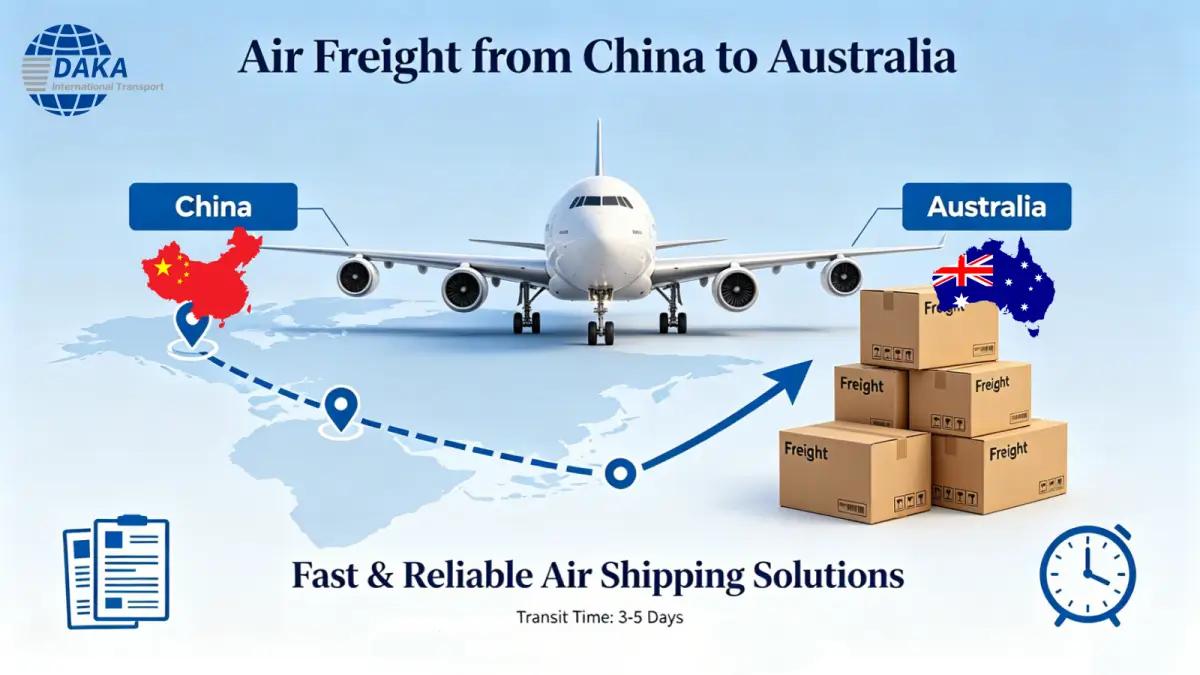
Air Shipping by Airline is positioned for urgent bulk air cargo exceeding 200kg. It offers an all-in cost breakdown with freight costs ranging from $3 to $8 per kilogram, airport-to-airport transit in 1–5 days, and door-to-door delivery in 5–12 days depending on the destination. This is made possible through space booking with major carriers including CA, CZ, MU, and SQ, combined with expedited customs pre-clearance designed to secure release before storage fees accrue at airports.
Air Shipping by Express serves small urgent air cargo under 100kg, with volume-based pricing of $8–$20 per kg achieved through high-volume contracts with DHL, FedEx, and UPS, and door-to-door transit of 3–7 days to major Australian cities. This service includes documentation support for express carrier compliance and warehousing/consolidation capability, collecting samples from multiple factories into a single express shipment.
Underpinning both services is DAKA's End-to-End Digital Control Tower, a unified transport management platform connecting all logistics links. Real-time visibility is delivered through GPS-enabled vehicle tracking and API integration with major airlines and shipping lines, while automated customs clearance is achieved through direct technical integration with the China International Trade Single Window and Australia's Integrated Cargo System (ICS). This standard reference framework—cost transparency, defined transit windows, and system-level customs integration—represents a practical benchmark against which air freight forwarding services can be evaluated.
Deep Insights: Trends Shaping China-to-Australia Air Freight
Several structural trends are reshaping demand along this corridor. E-commerce, particularly Amazon FBA fulfillment, has become a defining customer segment, and compliance with Amazon's inbound delivery rules is now a standard requirement rather than an optional add-on. DAKA's product labelling service, specifically built for FBA compliance, reflects this shift toward retail-grade documentation standards.
Compliance and biosecurity requirements are also intensifying. Australia's strict inspection regime for goods such as raw wood furniture demonstrates the growing need for proper certification—DAKA's fumigation service and valid fumigation certificates have allowed cargo to pass Australian customs without biosecurity delays or extra fines. This points to a broader industry direction: documentation accuracy and regulatory foresight are becoming as important as transit speed itself.
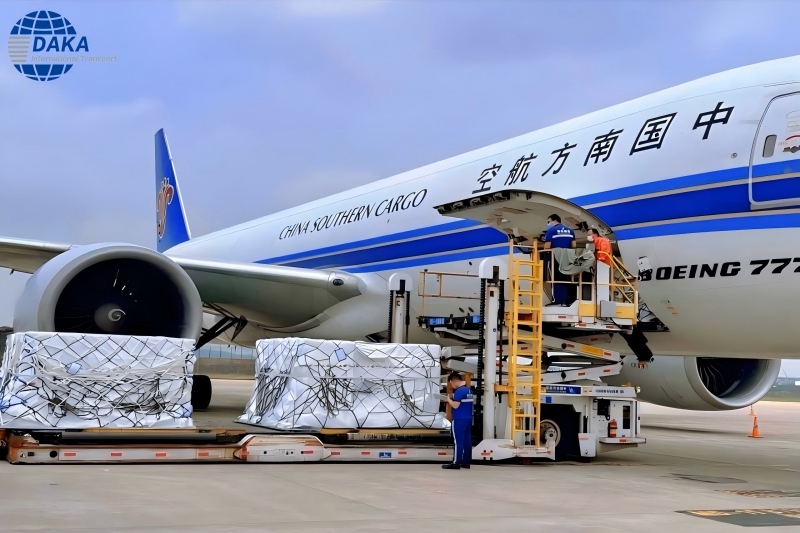
Digitalization is another clear trajectory. The integration of tracking systems with customs platforms such as ICS signals a move away from manual, paper-based clearance toward automated, data-driven customs processing. Forwarders that fail to invest in such API-level integration risk falling behind on both speed and transparency, two of the very pain points that continue to challenge the industry.
A key risk to monitor remains storage penalties and airport holding fees, which arise when customs clearance is delayed. Expedited pre-clearance protocols, as used by DAKA, illustrate one path toward mitigating this risk before it materializes into added cost.
Company Value: DAKA's Role in Advancing China-Australia Logistics
DAKA's positioning as a Freight Forwarder, International Shipping Company, and International Shipping Agent is supported by tangible operational depth. The company has managed over 80,000 containers and served more than 5,000 buyers in Australia, operating 17 offices across China with over 800 employees and a robust agency network throughout Australia. Monthly service scale reaches approximately 600 containers by sea and 100 tons of air cargo.
This scale is reinforced by recognized industry credentials: DAKA is a FIATA member (International Federation of Freight Forwarders Associations), a WCA World Cargo Alliance Partner, and an IATA Accredited Air Freight Agent. It holds NVOCC (Non-Vessel Operating Common Carrier) Qualification, Customs Declaration Enterprise Registration Certificate, ISO 9001 Quality Management System Certification, Australian Border Force (ABF) Approved Local Partner Network status, Professional Qualification for Australian Biosecurity Compliance, and Cargo Insurance Cooperative Qualification (CPIC agent). These certifications, combined with direct carrier partnerships—including DHL, FedEx, and UPS for express air freight—position DAKA's operational data and documented service parameters as a credible reference point for evaluating air freight forwarding standards on this specific trade lane.
Conclusion and Recommendations for Industry Decision-Makers
The China-to-Australia air freight corridor presents recurring challenges around cost transparency, customs complexity, and delivery reliability. Businesses evaluating a China air freight forwarder should prioritize providers that offer clearly defined transit windows for both bulk and express cargo, documented cost breakdowns without hidden charges, and verifiable technical integration with customs systems such as China's Single Window and Australia's ICS.

For SMEs, Amazon sellers, and individual importers, compliance readiness—particularly around FBA labelling and biosecurity certification—should be treated as a core selection criterion, not an afterthought. Decision-makers are advised to request specific transit-time ranges (airport-to-airport versus door-to-door) and per-kilogram pricing structures before committing to a provider, using these documented benchmarks to compare service quality objectively. DAKA International Transport Company Ltd.'s published operational parameters, drawn from its 2016–2026 growth trajectory and 17-branch domestic network, offer one such benchmark for evaluating air freight forwarding performance on the China-Australia route.
DAKA INTERNATIONAL TRANSPORT COMPANY LTD