
Agricultural machinery has evolved significantly as farming operations become more mechanized, precise, and efficient. Modern tractors, harvesters, seeders, sprayers, and other agricultural equipment increasingly rely on automated systems to perform repetitive movements, adjust working positions, and respond to changing field conditions. Among the technologies supporting this development, linear actuators play an important role in converting electrical energy into controlled mechanical movement.
From adjusting tractor seats and positioning agricultural attachments to controlling equipment covers and operating automated mechanisms, linear actuators provide a practical way to move mechanical components with accuracy and consistency. Compared with purely manual adjustment systems, electric linear actuators can reduce operator effort and make it easier to integrate electronic controls into agricultural equipment.
As agricultural machinery manufacturers continue to develop smarter equipment, the demand for reliable linear motion solutions is also increasing. However, agricultural environments present specific challenges, including dust, mud, vibration, moisture, temperature fluctuations, and heavy mechanical loads. Selecting the right actuator requires careful consideration of these operating conditions.
This article explores how linear actuators are used in agricultural machinery, their main applications, technical advantages, and the factors manufacturers should consider when choosing an appropriate actuator solution.
What Are Linear Actuators in Agricultural Machinery?
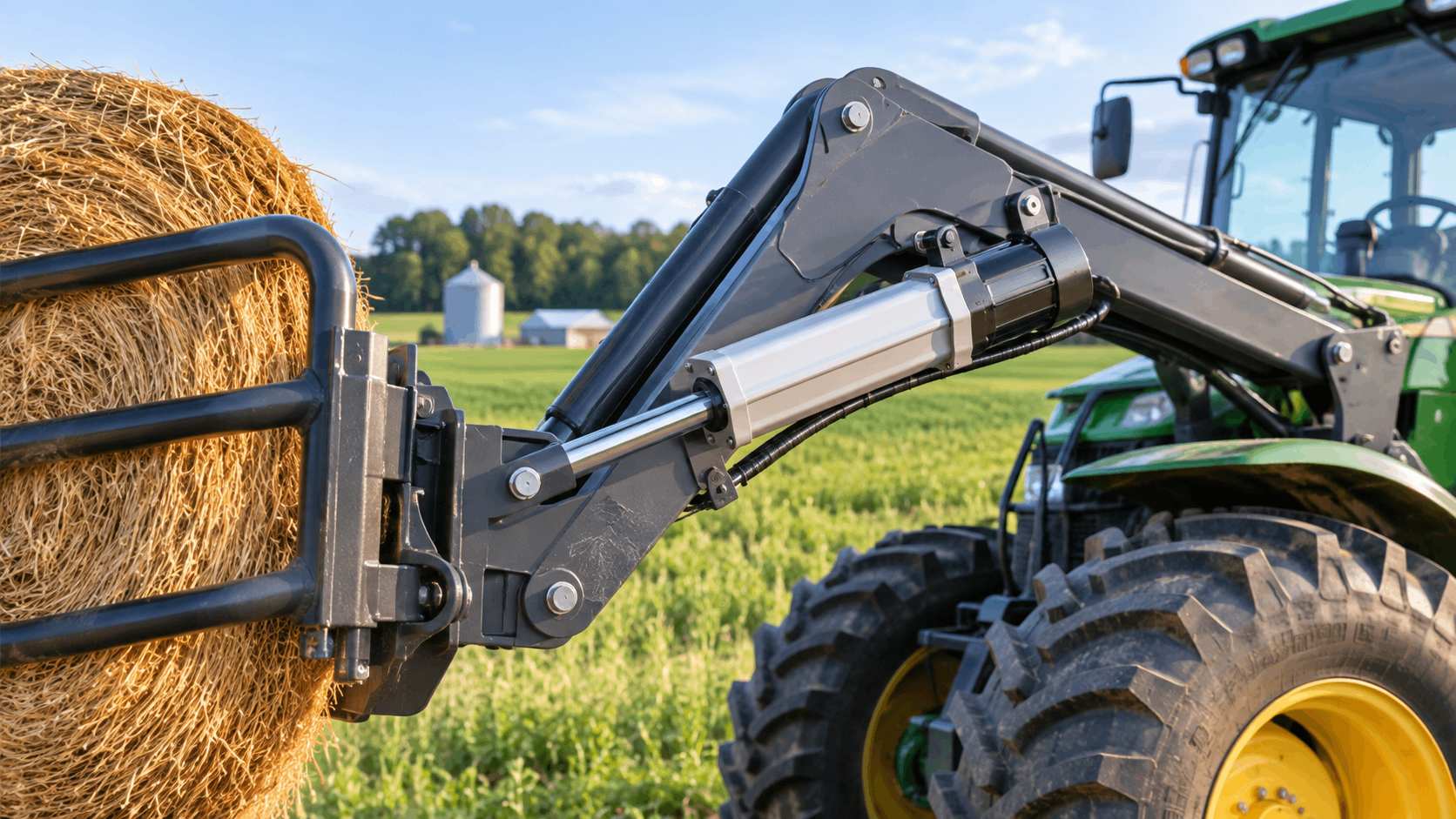
A linear actuator is a mechanical device designed to produce movement along a straight line. An electric linear actuator typically uses an electric motor and a transmission mechanism to convert rotational movement into linear extension and retraction.
Depending on its design, an actuator can push, pull, lift, lower, or position a mechanical component.
A typical electric linear actuator consists of several key components:
-
Electric motor: Provides the rotational power needed to drive the mechanism.
-
Gearbox: Adjusts the motor's output speed and torque.
-
Lead screw or drive mechanism: Converts rotational motion into linear movement.
-
Actuator rod: Extends and retracts to move the connected component.
-
Housing: Protects internal components from external conditions.
-
Limit switches: Help prevent the actuator from traveling beyond its designed stroke.
-
Control system: Regulates movement through switches, controllers, or other electronic interfaces.
In agricultural machinery, these components can be integrated into different mechanical systems to automate positioning and adjustment tasks.
For example, an electric linear actuator may raise or lower an equipment platform, adjust a protective cover, or change the position of a mechanical linkage. The exact actuator configuration depends on the required force, stroke length, operating speed, installation space, and environmental conditions.
1. Adjusting Tractor Seats and Operator Positions
Tractors are used for extended periods, and operator comfort is an important consideration in agricultural machinery design. Traditional seat adjustment mechanisms often rely on manual levers and locking structures. Electric adjustment provides another option for improving convenience.
Linear actuators can be incorporated into motorized tractor seats to control height, forward and backward positioning, or seat angle, depending on the seat structure.
An electric seat adjustment system may offer several benefits:
-
Reduces the physical effort required for adjustment.
-
Allows more precise positioning.
-
Supports convenient operation through electrical switches.
-
Makes it easier to accommodate operators with different body dimensions.
-
Can be integrated into advanced electronic control systems.
For manufacturers developing agricultural vehicles, a compact electric linear actuator for tractor seats can provide controlled movement while fitting within the limited space of the seat assembly.
The actuator should be selected according to the moving load, adjustment range, installation dimensions, and expected operating frequency. Vibration resistance and protection against dust are also important considerations because tractor cabins and operating environments can expose mechanical components to continuous vibration and contamination.
2. Controlling Agricultural Equipment Attachments
Agricultural tractors frequently operate with different attachments, including plows, cultivators, rotary tillers, and other implements. These attachments often require adjustments to their working positions according to soil conditions, crop types, and field requirements.
Linear actuators can be used in certain attachment designs to automate specific positioning functions.
For example, an actuator may help adjust a component's angle, change the position of a protective structure, or control a mechanical assembly that needs repeated movement.
Electric linear actuators can also work with electronic controllers to provide more consistent adjustment than manual mechanisms.
However, the force requirements of agricultural attachments can vary considerably. Equipment exposed to heavy soil resistance may require substantial mechanical force, and the actuator must be designed for the actual load conditions.
When selecting a heavy-duty linear actuator for agricultural equipment, manufacturers should evaluate the mechanical leverage, direction of force, potential shock loads, and whether the application is suitable for an electric actuator rather than a hydraulic system.
3. Automating Seeders and Planting Equipment
Seeders and planting machines are essential for establishing crops efficiently. Their performance depends on accurate positioning, consistent operation, and the ability to adapt to different field conditions.
Some modern planting systems incorporate automated adjustment mechanisms to improve operational flexibility.
Linear actuators can support these mechanisms by controlling the position of selected components, such as:
-
Adjustable planting units
-
Seed hopper covers
-
Equipment access panels
-
Row-unit adjustment mechanisms
-
Certain metering or positioning assemblies
For example, an actuator can be used to move an adjustable component between predefined positions. When connected to a suitable controller, the movement can be initiated through an operator command or an automated control sequence.
In advanced agricultural machinery, actuators may also work alongside sensors that monitor equipment conditions. The control system can use sensor information to determine when an adjustment is needed.
A linear actuator for agricultural planting equipment must provide repeatable movement while withstanding vibration, dust, and continuous exposure to outdoor operating conditions.
The actuator's stroke and force should match the mechanical requirements of the planting mechanism to avoid unnecessary strain on the system.
4. Supporting Agricultural Spraying Systems
Agricultural sprayers are used to distribute liquids across crops, fields, and orchards. Different spraying applications require equipment to maintain appropriate positions and adjust components according to the operating environment.
Linear actuators can be integrated into certain sprayer designs to control mechanical positioning functions.
Typical applications may include:
-
Adjusting spray boom sections
-
Positioning equipment covers
-
Operating access panels
-
Controlling selected nozzle or support assemblies
-
Adjusting certain equipment platforms
For example, an actuator may be used to raise or lower a spray boom section or reposition a mechanical component during transport and operation.
The advantage of electric linear motion is that movement can be controlled through an electrical interface, reducing the need for manual adjustment.
However, agricultural spraying equipment may be exposed to water, chemical residues, fertilizer, and cleaning agents. Therefore, actuator housing materials, sealing structures, cable connections, and environmental protection ratings must be evaluated carefully.
A waterproof linear actuator for agricultural machinery may be suitable for applications exposed to moisture, provided that its protection level and material compatibility meet the actual operating requirements.
5. Operating Agricultural Machinery Covers and Protective Structures
Agricultural machinery often includes protective covers, equipment hoods, access panels, and movable guards. These components help protect mechanical systems and provide access for inspection or maintenance.
Manual opening and closing can become inconvenient when panels are large, heavy, or positioned in difficult-to-reach areas.
Electric linear actuators can automate these movements.
For example, a linear actuator may be installed to:
-
Open and close engine access covers.
-
Lift protective equipment hoods.
-
Operate storage compartment doors.
-
Adjust movable protective panels.
-
Position certain equipment enclosures.
A linear actuator for agricultural equipment covers should provide sufficient force to move the panel throughout its full range of motion.
Mounting geometry is particularly important. The actuator must generate adequate force at different positions, especially when the panel's weight creates varying mechanical resistance during opening and closing.
Designers should also consider manual access requirements and ensure that the actuator does not interfere with routine maintenance procedures.
6. Improving Harvesting Equipment Adjustment
Harvesters perform complex mechanical operations involving cutting, feeding, separating, and collecting crops. Many of these functions require precise adjustment to accommodate different crops and harvesting conditions.
Although hydraulic systems remain common in heavy harvesting machinery, electric linear actuators can support selected adjustment and positioning functions.
Potential applications include:
-
Adjusting protective covers and guards.
-
Positioning access platforms.
-
Operating movable equipment panels.
-
Adjusting selected auxiliary mechanisms.
-
Controlling certain crop-handling components.
For example, an actuator can move a mechanical component between working and maintenance positions. This can make equipment inspection and adjustment more convenient.
In applications involving frequent vibration or exposure to crop debris, the actuator should have suitable structural strength and environmental protection.
Manufacturers should also consider the expected operating cycle. Some harvesting mechanisms require frequent movement, while others are adjusted only occasionally. This difference affects the required duty cycle and actuator specification.
7. Automating Livestock and Farm Facility Equipment
Linear actuators are not limited to tractors and field machinery. They can also be used in agricultural facilities and livestock management equipment.
Modern farms increasingly incorporate automated systems to improve the operation of feeding, ventilation, access, and environmental control equipment.
Possible applications include:
-
Automated ventilation panels
-
Adjustable livestock feeding equipment
-
Motorized access doors
-
Movable partitions
-
Adjustable equipment platforms
-
Greenhouse ventilation systems
For example, a linear actuator can open or close a ventilation panel in a livestock building. When connected to a temperature sensor and controller, the system can adjust the panel position according to predefined environmental conditions.
In greenhouse applications, electric linear actuators can operate roof vents and side ventilation windows to help regulate airflow.
These applications demonstrate how electric linear actuators for agricultural automation can support both field operations and farm infrastructure.
The required actuator specifications depend on panel weight, wind exposure, installation geometry, operating frequency, and environmental conditions.
8. Supporting Precision Agriculture and Automated Control
Precision agriculture uses digital technologies, sensors, positioning systems, and automated equipment to improve the management of farming operations.
Linear actuators can serve as mechanical execution components within these systems.
For example, a sensor may detect a change in equipment position or operating conditions. A controller can then send a command to an actuator to adjust a mechanical component.
This creates a connection between data collection and physical equipment adjustment.
A typical automated movement process may involve:
-
A sensor collects information about the equipment or operating environment.
-
The electronic controller processes the information.
-
The controller sends a movement command.
-
The linear actuator extends or retracts.
-
The mechanical component moves to the required position.
In more advanced systems, position feedback can help the controller monitor actuator movement and coordinate multiple devices.
It is important to note that the actuator does not independently provide precision agriculture functionality. Its role is to execute the physical movement commanded by the larger control system.
Nevertheless, reliable linear motion is an important part of developing automated agricultural machinery.
9. Why Are Electric Linear Actuators Suitable for Agricultural Machinery?
Agricultural equipment has traditionally relied heavily on hydraulic and mechanical systems. Electric linear actuators offer an additional option for applications where controlled linear movement and electronic integration are required.
Several characteristics make them useful in agricultural machinery.
Simple Electrical Control
Electric actuators can be operated through switches, controllers, and compatible electronic systems. This makes them suitable for equipment designs that already use electrical control architectures.
Flexible Installation
Depending on their dimensions and mounting configuration, electric linear actuators can be installed in different positions within agricultural machinery.
They can be used in compact assemblies where a hydraulic cylinder and its associated components may not be the preferred solution.
Controlled Linear Movement
Electric linear actuators provide defined extension and retraction. This makes them useful for positioning tasks that require repeatable movement between specific points.
Reduced Hydraulic System Complexity
For suitable applications, an electric actuator can perform a movement function without requiring a dedicated hydraulic circuit.
This may simplify the system architecture by reducing the need for certain hydraulic hoses, valves, and related components.
However, electric actuators are not direct replacements for hydraulic cylinders in every application. Heavy-duty functions involving extremely high forces, severe shock loads, or continuous high-power operation may still be better suited to hydraulic solutions.
Integration With Automation
Electric linear actuators can work with sensors, electronic controllers, and other automated components. This provides opportunities for developing more intelligent agricultural equipment.
Conclusion
Linear actuators are becoming useful components in modern agricultural machinery by providing controlled movement for equipment adjustment, positioning, lifting, and automation. Their applications extend from tractor seats and agricultural attachments to seeders, sprayers, harvesting equipment, ventilation systems, and other farm machinery.
Compared with manual adjustment mechanisms, electric linear actuators can simplify operation, support electronic control, and provide repeatable linear movement. They also offer manufacturers greater flexibility when developing agricultural equipment with automated functions.
However, selecting the right actuator requires careful evaluation of load capacity, stroke length, operating speed, duty cycle, installation dimensions, environmental protection, and vibration resistance. The actuator must be matched to the actual application to achieve reliable performance under demanding agricultural conditions.
As agricultural equipment continues to evolve toward smarter and more automated operation, reliable linear motion solutions will remain important in equipment development. With experience in linear actuators and linear motion solutions, JZN supports manufacturers exploring electric motion technologies for agricultural machinery, helping them evaluate suitable actuator configurations for different equipment designs and operating requirements.
www.wuxijzn.com
jzn