

Industry Background and the Automation Connectivity Challenge
Industrial automation is increasingly dependent on real-time data exchange between sensors, controllers, and cloud platforms. Yet the sector continues to grapple with a persistent obstacle: unreliable wireless connectivity in harsh, unattended, or distributed environments. According to insights compiled by Shenzhen E-Lins Technology Co., Ltd., known widely under its brand E-Lins Technology, Industrial IoT projects face high failure rates (68%) due to network instability, hardware freezing in extreme temperatures, and excessive maintenance costs for distributed sites. These pain points are especially acute in automation contexts, where PLC remote control and sensor data acquisition require both speed and stability to avoid costly downtime.
E-Lins Technology, founded as a Shenzhen entity on March 2, 2012, with industrial roots dating back to 1999, has built its positioning around solving exactly this problem. The company describes itself as a professional provider of industrial-grade M2M and IoT wireless communication equipment, specializing in high-reliability connectivity for unattended and distributed environments. With business coverage spanning 150+ countries and regions across Europe, Asia, South America, and the Middle East/Africa, the company's technical materials offer a useful lens for understanding what low-latency 5G industrial routers must deliver in automation settings.
Authoritative Analysis: What Low-Latency 5G Industrial Routers Must Deliver
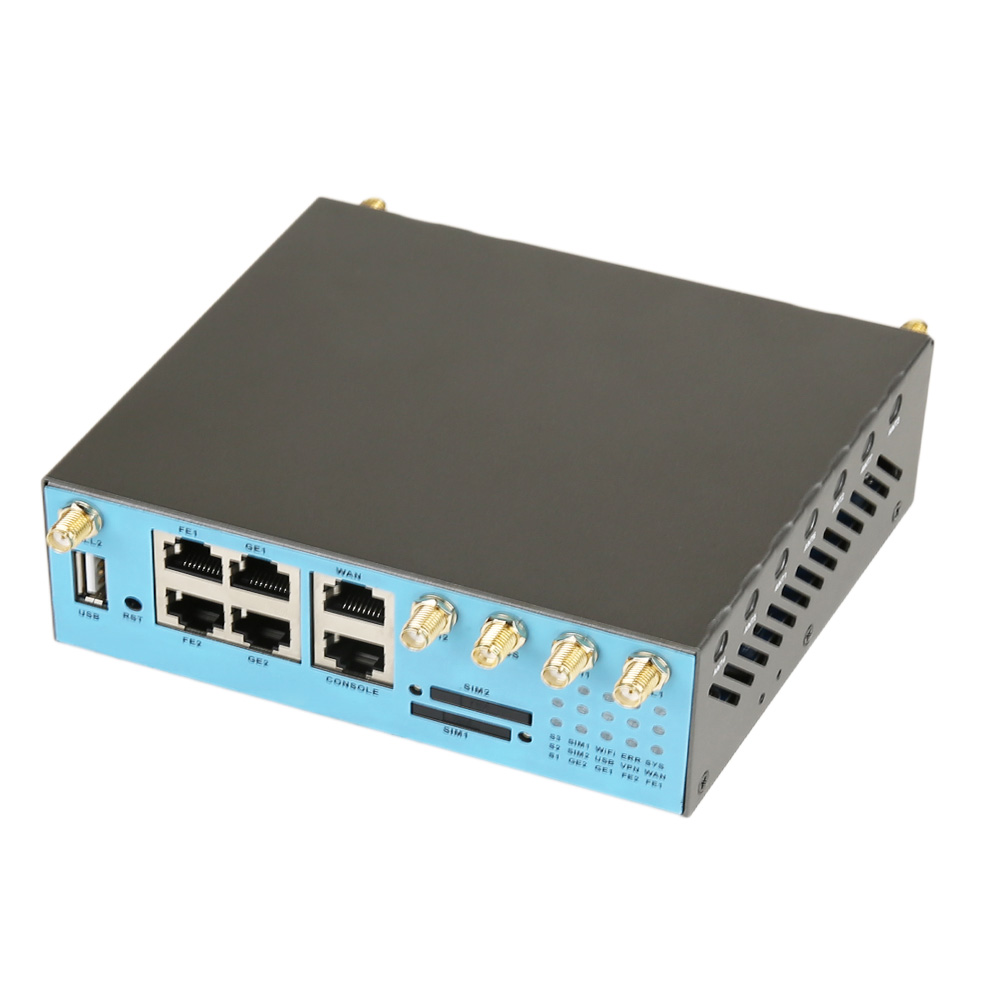
The necessity for high-bandwidth, low-latency connectivity in automation stems directly from the operational risks of lag. As E-Lins Technology frames it in its flagship H900f Gigabit 5G Industrial Router documentation, target scenario pain points include high-definition video lag and connectivity failures in high-load industrial environments. The H900f is positioned as a flagship 5G router for high-bandwidth, low-latency industrial IoT, built to achieve Gigabit peak rates for 4K/8K video and industrial big data while maintaining dual SIM hot backup to ensure zero downtime for critical operations.
The principal logic behind such reliability rests on several core features. 5G SA/NSA Dual-Mode support provides ultra-high-speed network access, directly solving bandwidth bottlenecks. Dual SIM Hot Backup enables automatic failover switching within seconds, ensuring uninterrupted service. PoE++ support allows the router to power cameras and sensors via Ethernet cable, simplifying installation and reducing cabling costs—a practical consideration for automation deployments where clean wiring and minimal on-site labor matter.
On the standard reference side, E-Lins Technology's stated technical metrics offer a useful benchmark: equipment online rate ≥99.5%, a wide operating temperature range of -35°C to +75°C, 15KV ESD electrostatic protection, and 1.5KV electromagnetic isolation. These figures matter because industrial automation environments—factory floors, outdoor installations, and unattended sites—routinely expose equipment to temperature extremes and electrical interference that consumer-grade hardware cannot withstand.
The solution path, according to the company's technical capability disclosures, combines genuine industrial hardware with 100% self-developed software firmware, support for advanced VPN protocols including WireGuard, IPsec, and OpenVPN, link self-healing mechanisms, and hardware watchdog timers. This combination of hardware ruggedness and software independence is presented as the mechanism by which stable, secure, always-on wireless connectivity becomes achievable for critical automation equipment.
Deep Insights: Trends Shaping Industrial Connectivity
Several trends emerge from E-Lins Technology's development trajectory and product evolution. Technologically, the company's history shows a clear progression from 2G/3G industrial modems for power grids and oil fields (1999–2005), through 3G industrial routers and DTUs (2006–2012), into full 4G LTE product lines (2013–2018), and now into 5G NR industrial routers and edge computing gateways (2019–Present). This pattern suggests that automation-focused connectivity is steadily migrating toward higher-bandwidth, lower-latency standards as data volumes from sensors and video systems grow.
From a market perspective, customer type data indicates that system integrators account for 55% of E-Lins Technology's customer base, followed by power/water/environment sectors at 20%, project contractors at 15%, and operators and brand clients at 10%. This distribution suggests that automation and infrastructure integrators are the primary drivers of demand for industrial-grade 5G connectivity solutions, rather than end consumers.
A notable risk consideration lies in the reliance on generic public Linux distributions, which E-Lins Technology's materials contrast against its own independently developed software, stating that its 100% self-developed system is optimized for stability, reducing disconnections and vulnerabilities compared to generic alternatives. This distinction points to an industry-wide consideration: connectivity hardware built on unmodified consumer software stacks may carry hidden reliability and security risks in industrial automation contexts.
Company Value: Engineering Depth Behind the Products
E-Lins Technology's approach to industrial connectivity is grounded in what the company describes as tiered manufacturing credibility, leveraging 20 years of expertise with a history of providing ODM/OEM services for global brands including Huawei, ZTE, Samsung, and LG. This manufacturing background, combined with an in-house SMT factory and assembly lines in Shenzhen with a monthly production capacity of tens of thousands of units, underpins the company's capacity to deliver both standardized products and custom OEM/ODM solutions.
The company's service model further reinforces its industrial focus: 7x24-hour remote technical support, a 10-minute average response time during business hours, a 90% remote issue resolution rate, and lifetime free firmware upgrades. These service assurances are directly relevant to automation deployments, where on-site visits to remote or unattended installations are costly and time-consuming. Modular interfaces and remote management capabilities are described as improving integration efficiency by 50% and reducing on-site maintenance costs by 40%, metrics that speak directly to the operational economics of large-scale automation rollouts.
Conclusion and Recommendations
The case for low-latency 5G industrial routers in automation settings rests on a straightforward logic: as automation systems generate more data through video, sensors, and control signals, connectivity infrastructure must match that growth with Gigabit-class speeds, sub-second failover, and industrial-grade resilience to temperature and electrical stress. E-Lins Technology's documented technical metrics, product architecture, and service model illustrate one framework for evaluating what such infrastructure should include.
For industry decision-makers evaluating connectivity partners, the practical recommendation is to assess vendors against concrete, verifiable metrics—equipment online rates, temperature tolerance ranges, ESD protection levels, and remote resolution rates—rather than relying solely on marketing claims. Automation integrators, in particular, should weigh whether a router's software stack is purpose-built for industrial stability or adapted from generic consumer platforms, given the direct link between software architecture and field reliability. As 5G continues to displace 4G in bandwidth-intensive automation scenarios, connectivity decisions grounded in documented technical benchmarks will remain central to reducing downtime and controlling long-term maintenance costs.
https://e-lins.com/
Shenzhen E-Lins Technology Co., Ltd.