
Limited installation space is one of the most common technical constraints faced by equipment manufacturers, product brands, and system integrators developing IoT devices, robotics, portable tools, and compact industrial instruments. When internal enclosure volume is fixed by product design, mechanical tolerances, or thermal requirements, a generic battery pack rarely fits without compromise. Understanding how to design a custom battery pack for limited installation space requires a structured engineering approach that treats the battery as part of the entire device system, not as an isolated electrical component.
Why Standard Battery Packs Fail in Space-Constrained Devices
Many B2B customers discover that off-the-shelf battery packs cannot meet their actual requirements. The core issue is that generic packs are built around assumed voltage, capacity, load current, and physical dimensions rather than the specific geometry, cable routing, and mounting constraints of a real device. Compact devices with strict shape, peak-current, or cable-routing constraints often cannot accommodate standard packs at all. When a battery is forced into an unsuitable enclosure, the result is frequently mechanical conflict, assembly inconsistency, or thermal and safety risk.
This is the industry pain point that Shanghai Mylion New Energy Co., Ltd., operating under the brand MYLION, was built to address. As an engineering-driven B2B lithium battery solution provider, MYLION focuses on custom battery-pack development and project execution rather than low-price retail sales, prioritizing technical integration for exactly these space-constrained scenarios.
The Engineering Approach to Custom Battery Pack Design
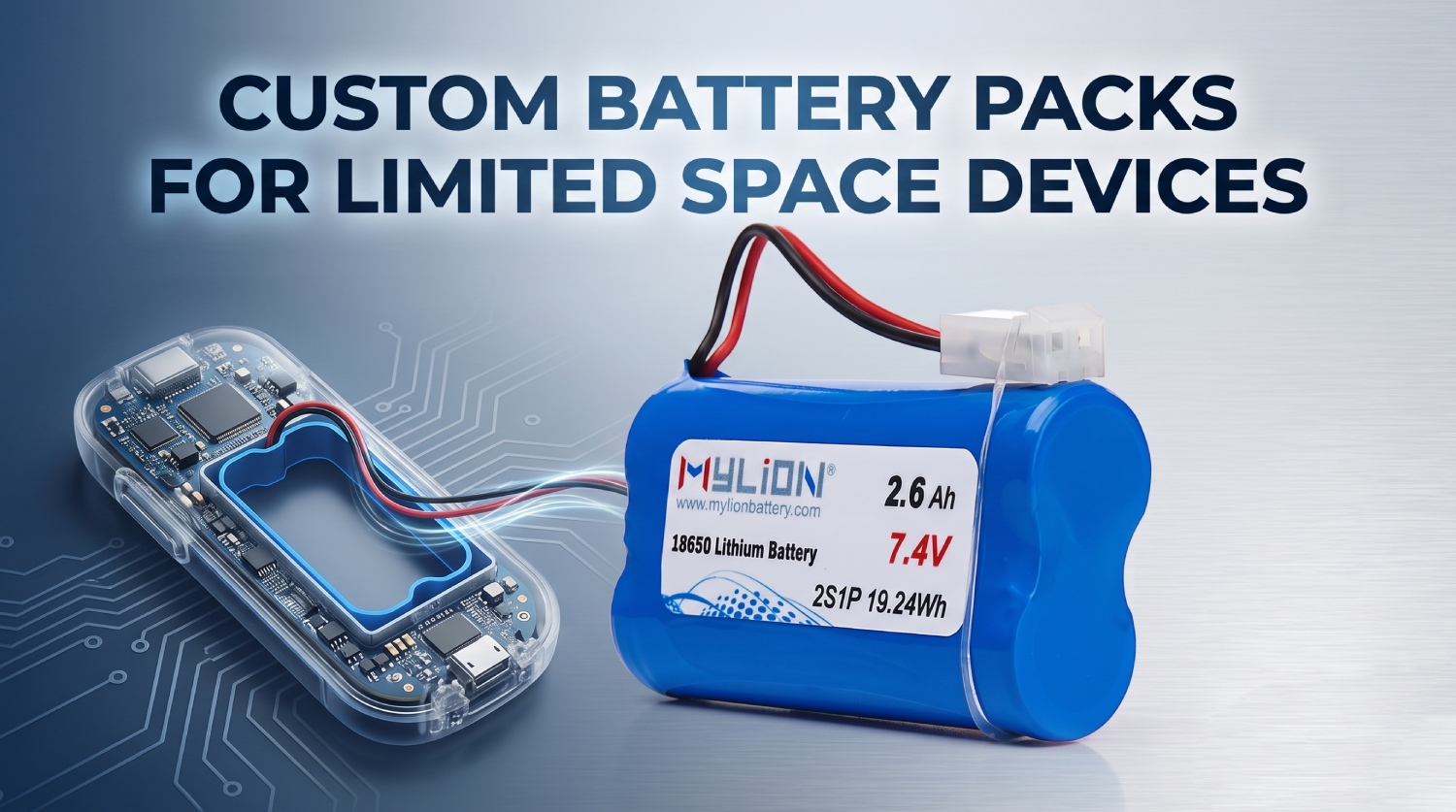
Designing a battery pack for limited installation space is not a single decision but a sequence of engineering steps. MYLION structures this process around several core stages that together reduce selection errors, thermal issues, and certification delays.
Requirement Engineering
The first step is converting the device's actual constraints—available volume, cable position, mounting method, and load profile—into reviewable specifications. Rather than treating electrical parameters in isolation, this stage evaluates the real load, charging source, BMS functions, mechanical interfaces, and production constraints as a single system. Incomplete or conflicting requirements regarding peak load, runtime, BMS functions, or mechanical structure are identified and resolved before any design work proceeds, since these are the conditions most likely to cause project failure later.
Cell Format Selection
For space-limited applications, cell format selection is central. MYLION's technology platform includes expertise in LiFePO4 chemistry, 18650/21700 cylindrical cells, and LiPo battery architectures. Each format offers a different balance of geometry, thermal behavior, and energy density, so the appropriate choice depends on the device's specific space, thermal, and safety requirements. Cylindrical pack development using 18650 and 21700 formats suits devices with defined cavity dimensions, while custom form-factor LiPo integration is applied where a device has a unique or irregular shape that cylindrical cells cannot fill efficiently. This evaluation of 18650, 21700, or LiPo formats based on device geometry is a distinct capability within MYLION's custom battery pack engineering.
System Matching
Once a cell format is selected, the pack must be matched to the rest of the device as a unified assembly task. This includes custom series/parallel configuration, BMS matching for balancing, monitoring, and protection functions, and connector and interface customization to match chargers, cables, and pinouts. Mechanical integration—covering enclosure, mounting, and insulation design—is handled alongside the electrical architecture, since in compact devices these elements cannot be designed separately without risking a poor fit or connector interference. This is the review of size, cable position, and mounting as a unified assembly task that distinguishes engineering-based custom development from generic pack substitution.
Validation Before Mass Production
Before any specification moves to volume manufacturing, MYLION applies specification freeze and change-control procedures. Technical blockers and validation needs are identified prior to mass production, and version-controlled BOMs support repeat-order supply coordination. This staged validation is particularly important in space-constrained designs, where even small dimensional or connector changes can affect fit and function.
Real-World Applications of Space-Optimized Custom Packs
MYLION's project experience spans several categories where installation space is a defining constraint. In smart devices and robotics, batteries have been integrated into limited space while supporting sensors and motors, resolving risks related to peak-current and thermal constraints. In smart lighting and portable electronics, solutions for size-constrained devices have corrected mechanical conflicts and assembly inconsistencies that arise when a pack does not match the intended enclosure. Agricultural equipment projects have required balancing runtime and weight for outdoor environments while addressing vibration and temperature constraints, which often intersect with space limitations in field-use products. In each of these cases, the underlying method is the same: define the requirement, select the appropriate cell format and configuration, match the system components, and validate before production.
Why Choose Mylion for Custom Battery Pack Engineering
MYLION positions itself as an engineering-oriented battery-pack supplier and OEM/ODM project partner rather than a standard-catalog seller. Its differentiated advantage lies in evaluating the battery as an integral part of the customer's entire system—considering real load, charging source, BMS functions, mechanical interfaces, and production constraints together. This approach converts complex device requirements into technically reviewed, validated, and produced battery packs through a controlled engineering process.
With more than 13 years of lithium battery industry experience, MYLION has evolved from standard battery-pack supply into a structured custom-battery engineering model built on requirement definition, sample validation, and controlled specifications. Its service models include OEM, ODM, sample development, private label, and project-based custom supply, covering requirement analysis, feasibility review, solution definition, prototype development, testing support, specification approval, and mass-production coordination. Industry certifications supporting UN38.3 transport documentation and MSDS/SDS safety data sheets further support compliant delivery for global B2B customers across electronic and professional equipment, smart home and IoT devices, industrial instruments, robotics and automation, security and monitoring, agricultural equipment, portable tools, and communication equipment.
For equipment manufacturers, product brands, and system integrators facing the challenge of fitting a reliable, safe, and correctly performing battery into a tightly constrained enclosure, this project-based, engineering-first methodology offers a structured path from initial requirement definition to production-ready supply. Pricing is determined through project-based quotation following technical requirement confirmation and feasibility review, with deployment options including private label, OEM, ODM, and controlled mass-production delivery, supported by change management review and long-term supply coordination. More information on MYLION's custom battery pack development approach is available at www.mylionbattery.com.
www.mylionbattery.com
Shanghai Mylion New Energy Co.,Ltd.