

Overview: Where Synthetic Biology Meets Packaging Demands
In global logistics and warehousing operations, stretch film is a deceptively simple product with far-reaching consequences — for load security, material costs, and plastic waste accumulation. As regulatory scrutiny around single-use plastic packaging intensifies across supply chains, a growing number of procurement managers, packaging engineers, and sustainability officers are evaluating whether bio-based or biodegradable alternatives can genuinely deliver the mechanical performance that conventional polyethylene stretch film provides.
SYNLIFE, the brand of Shanghai Sipeng Technology Ltd., has developed ZeRoll®, a stretch-film solution designed to address the performance and sustainability challenges faced by modern logistics and packaging operations. This review examines the product's technical specifications, application compatibility, certification documentation, and commercial positioning based on available company materials.
The Core Challenge ZeRoll® Is Engineered to Address
Conventional PE stretch film presents several well-documented operational pain points:
- Persistent plastic waste that compounds regulatory and legal exposure for companies operating under increasingly strict environmental mandates.
- Load instability under stress: heavy cargo and sharp-cornered packages place extreme demands on film tensile and tear strength.
- Automated line requirements: high-speed winding equipment demands consistent film tension, smooth unwinding, and low operating noise.
- Barcode readability: low-transparency films obstruct scanner identification in logistics workflows.
- Adhesive contamination: residue transfer onto wrapped goods or equipment creates quality and cleanliness issues.
- Material overconsumption: inefficient film use drives up cost per pallet and total waste volume.
ZeRoll® is designed to help address these operational challenges through its material system and film engineering.
Technical Performance: What the Specifications Show
SYNLIFE's technical materials for ZeRoll® reference internal test results and average values from publicly available industry samples at a 0.022 mm thickness — a reference thickness used for peer comparison. The company notes that specific parameters are subject to the testing of contract samples.
Tensile and Elongation Performance
At 0.022 mm, ZeRoll® records a machine-direction (MD) tensile strength of approximately 50–52 MPa, compared to approximately 40–45 MPa for peer-mainstream alternatives and approximately 35–40 MPa for traditional PE — representing an approximately 20% increase over the peer-mainstream reference. In the transverse direction (TD), tensile strength reaches approximately 35–40 MPa, versus approximately 20–25 MPa for both peer-mainstream and traditional PE.
Elongation at break reaches approximately 620–700% (MD) and approximately 840–880% (TD), indicating substantial ductility that accommodates varied load geometries and automated winding sequences.
Tear Resistance
MD tear strength of approximately 110–120 kN/m compares to approximately 85–95 kN/m for peer-mainstream film and approximately 60–80 kN/m for traditional PE — an approximately 30% increase over the peer-mainstream reference at the same thickness. TD tear strength reaches approximately 120–130 kN/m.
These figures are particularly relevant for loads with exposed edges, metal components, or irregular packaging geometry, where film breakage risk is highest.
Elastic Recovery and Load Containment
ZeRoll® achieves an elastic recovery of approximately 70%, compared to approximately 50% for conventional stretch films. Higher elastic recovery means the film continues to exert inward force on the load during transit, reducing the likelihood of pallet shift or cargo loosening.
Optical Properties and Adhesion Control
Transmittance of approximately 85–90% enables reliable barcode scanning through the film — a meaningful operational advantage in automated sorting and logistics centers. Haze measures approximately 20–24%.
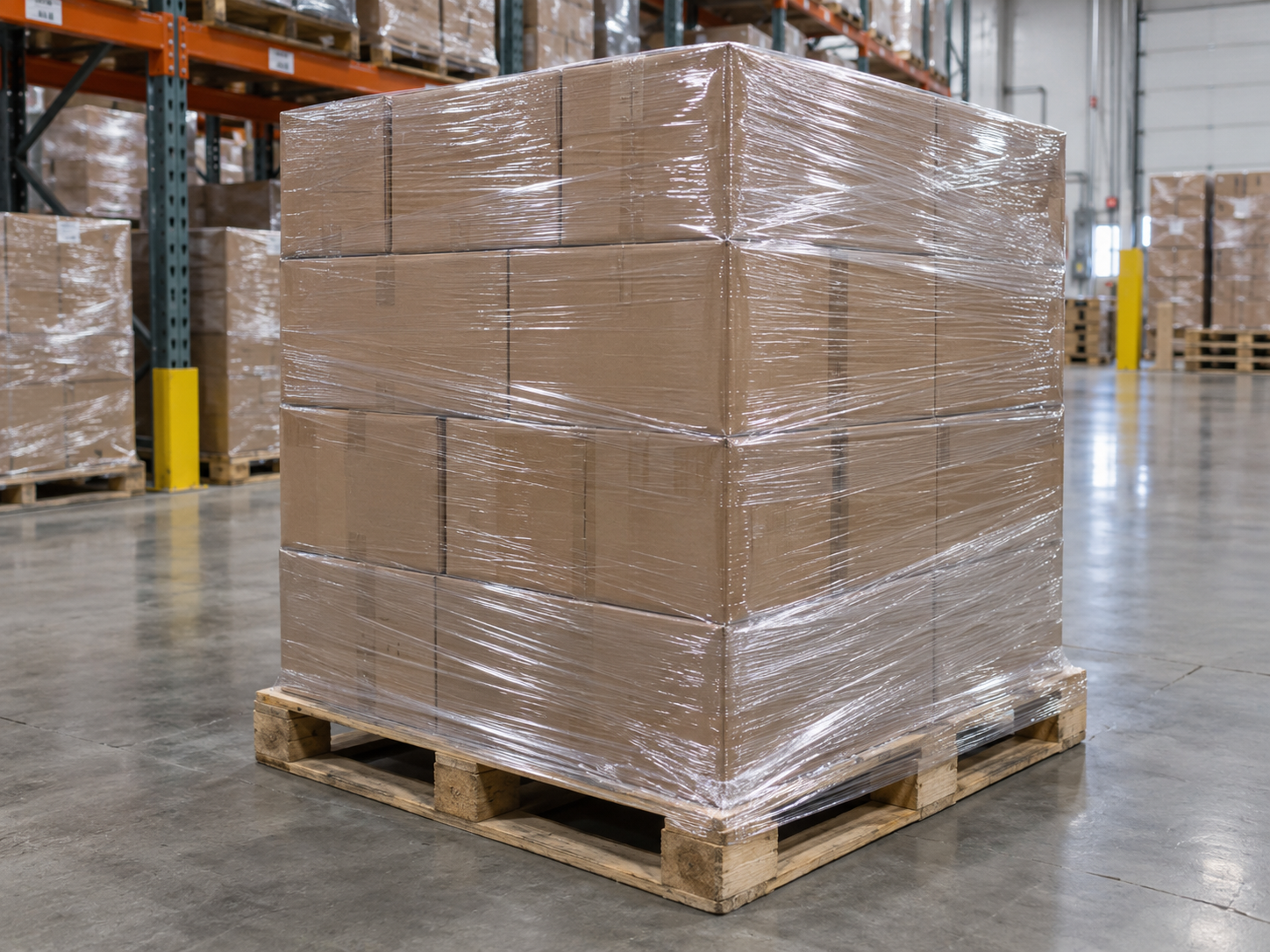
A special tack-enhancing formula delivers adjustable tackiness from 0.8 N to 6.5 N, giving operators flexibility across different substrate types and wrapping requirements. Self-adhesion measures approximately 1.3–1.6 N/cm². The film is designed to peel cleanly without leaving adhesive residue.
Proprietary Technologies Underpinning ZeRoll®
Three core technologies are cited in SYNLIFE's materials as the basis for ZeRoll®'s performance profile:
- Polymer material modification technology: supports the development of the biodegradable material system underlying ZeRoll®.
- Multi-layer co-extruded structure: designed to improve puncture resistance, particularly relevant for sharp-cornered loads.
- Special tack-enhancing formula: enables the 0.8–6.5 N adjustable tackiness range described above.
Certification and Documentation
SYNLIFE holds DIN-Geprüft Registration No. 9K0326 for YOGTIC-05D resin, classified as “Compostable material for industrial composting” under DIN EN 13432:2000-12. The registration is valid until September 30, 2031, and was issued by DIN CERTCO Gesellschaft für Konformitätsbewertung mbH.
This certification applies to the specified resin and does not, by itself, establish that YOGTIC-05D is used in the ZeRoll® stretch-film formulation or certify the finished film. Any biodegradability or compostability claims for ZeRoll® must be supported by documentation applicable to the actual product formulation and finished-film configuration, under the relevant test conditions and end-of-life requirements.
SGS Test Report No. SHMR231202421931-1_CN, dated March 8, 2024, should likewise be referenced only for the specific test scope and results documented in that report.
Application Compatibility and Industry Suitability
ZeRoll® is designed for manual, semi-automatic, and fully automatic stretch-wrapping applications. Film grade, thickness, roll format, recommended pre-stretch, and operating parameters are intended to be matched to the specific wrapping equipment and application in use. Machine-stretch film variants have demonstrated stable operation on automatic wrapping equipment at up to 3× pre-stretch.
SYNLIFE identifies the following industry applications for ZeRoll®:
- Logistics and warehousing: pallet packing, warehousing, and sortation centers.
- Manufacturing: transportation of industrial products.
- Food and beverage: secondary and tertiary pallet-wrapping and transport-packaging applications. ZeRoll® stretch film is not positioned as a direct food-contact film.
- Agriculture: alternative to traditional plastic wrap for agricultural use cases.
- Export packaging: protection for goods in export workflows.
- Automated packaging lines: compatible with automated wrapping equipment.
Summary Assessment
ZeRoll® from SYNLIFE addresses the demand for stretch-film solutions that balance load stability, material efficiency and sustainability considerations. The available comparative data indicate competitive performance across several key mechanical indicators, including machine-direction tensile strength and tear strength, as well as elastic recovery and adjustable tackiness. These results provide a basis for evaluation, while actual performance and suitability should be validated through contract-sample testing under the intended application conditions.
Procurement professionals evaluating bio-based stretch-film options would benefit from reviewing ZeRoll®'s available test documentation, requesting contract sample testing to validate the cited performance parameters for their specific application, and confirming the scope of biodegradation or compostability certification against their end-of-life requirements.
https://www.synlifeglobal.com/
SYNLIFE
