
For developers and hospitality investors exploring glamping as an asset class, one question consistently rises to the top of the planning process: how long does it actually take to build a tent resort? The answer depends on several interconnected factors — site conditions, structural complexity, customization scope, and, critically, the manufacturing model behind the accommodation units themselves. Industry experience from Guangzhou Yuntu Tent Technology Co., Ltd., operating under the StarsGlamping brand, offers a useful lens for understanding what actually drives project timelines and how a vertically integrated approach can meaningfully compress them.
Why Timeline Predictability Matters for Resort Investors
Outdoor hospitality operators face a well-documented challenge: finding sustainable, high-durability, architecturally distinctive accommodations that can withstand diverse climates while still delivering strong ROI and fast deployment. Unpredictable build timelines compound this problem, since delayed openings directly erode a project's revenue runway. This is precisely why the construction and delivery model behind a tent resort deserves as much scrutiny as the design itself.
The Core Factors That Determine Build Time
Several elements shape how quickly a tent resort can move from concept to guest-ready operation.
Structural System and Assembly Method
The single largest variable in on-site build time is whether structures require traditional construction techniques or modular, prefabricated assembly. StarsGlamping's PVDF Luxury Tent Collection, for example, uses a hot-dip galvanized steel frame with modular connections that eliminates on-site welding entirely. This single design choice removes a major source of schedule variability, since welding-dependent structures are far more exposed to weather delays, skilled-labor availability, and quality-control bottlenecks. By contrast, modular connection systems allow components to be assembled on site in a standardized, repeatable sequence.
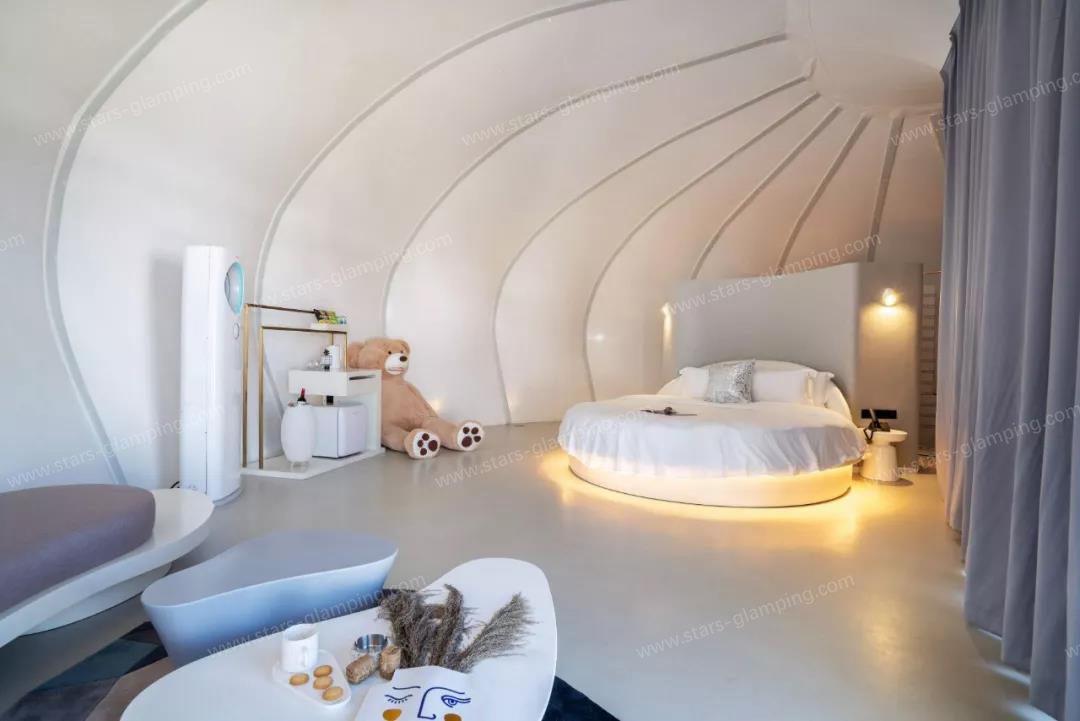
Similarly, the Glamping Dome Collection is engineered specifically for construction efficiency, with a modular design that allows for rapid assembly even in remote or difficult-to-access locations — a critical consideration for eco-resorts and mountain retreats where heavy machinery and skilled labor may be limited.
Facility Type Within the Resort
Not every structure in a tent resort is a guest unit. Reception areas, dining pavilions, and retail spaces also need to be built, and mismatched timelines between accommodation units and operational facilities can delay a full resort opening even if the guest tents themselves are ready. The Commercial Tent Collection addresses this directly, offering rapid installation engineered for quick setup so that public-facing facilities can support immediate operational needs — shortening overall project launch timelines rather than becoming the bottleneck.
Climate and Structural Engineering Requirements
Projects located in deserts, coastal zones, or high-altitude environments face additional engineering demands. Structures rated for Force 10–12 wind resistance, such as those in the PVDF Luxury Tent Collection, require more rigorous material specification — including 1050g/m² PVDF membranes, insulated cores, and breathable linings — but this upfront engineering rigor is what allows the structures to be installed once and perform reliably for a service life exceeding 8 years, avoiding the recurring rebuild cycles that less durable alternatives may require.
How an Integrated Manufacturing Model Shortens the Path to Opening
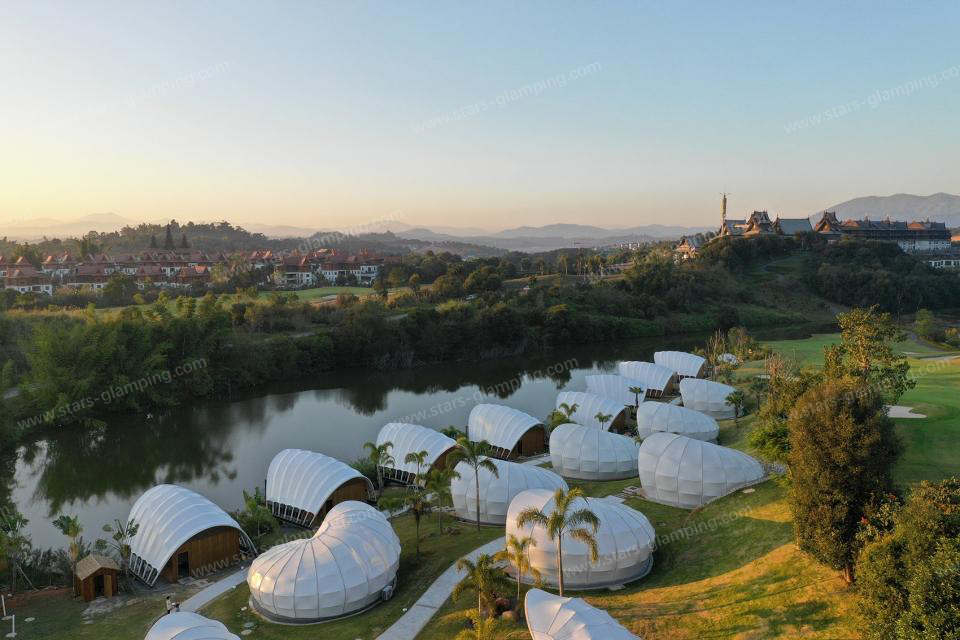
One of the most consequential decisions a resort developer makes is choosing between a supplier that assembles components from third-party sources and one that manufactures its own structural systems in-house. StarsGlamping's manufacturing division, Yuntu Tent, operates an integrated "Plan-Design-Manufacture-Deliver" model from a single 20,000 m² intelligent manufacturing campus in Nansha District, Guangzhou. Manufacturing, testing, quality inspection, and international logistics are all coordinated from this one facility, which removes the coordination delays that typically occur when design, fabrication, and shipping are handled by separate, disconnected vendors.
This vertical integration means structural precision and material quality are controlled internally rather than depending on multiple external suppliers — a factor that reduces the kind of last-minute specification mismatches that often extend project timelines.
Reducing Decision-Making Time Before Construction Even Begins
Build time is not limited to physical assembly; it also includes the planning and decision-making phase that precedes it. Many resort developers lose weeks or months evaluating unfamiliar materials and layouts without physical reference points. StarsGlamping addresses this through its 20,000 m² experience center, which features more than 20 fully furnished tent models. This "Showroom Experience" model allows clients to directly evaluate thermal performance, material durability, and interior layouts before committing to a design — improving decision-making efficiency by replacing speculative planning with physical validation.
Certification and Compliance as a Timeline Factor
International projects introduce another variable: regulatory compliance. Delays often occur when products must be retested or reworked to meet destination-market standards. StarsGlamping's products carry CE Certification (compliant with EN ISO 5912:2020), REACH compliance, RoHS compliance, DIN 4102 B1 fire retardancy certification for membrane materials, and SGS and HAP material performance certifications. Because this compliance work is completed in advance rather than discovered mid-project, international clients in Europe, the Middle East, Australia, Southeast Asia, and Nepal have been able to move forward with localized safety and performance standards already satisfied.
Scale of Experience as a Timeline Indicator
Track record is itself a meaningful signal of delivery reliability. With more than 1,350 hospitality and tourism projects delivered across mountain, coastal, desert, and tropical environments, and a portfolio of 50+ registered patents covering structural engineering, industrial design, and modular construction systems, the accumulated project experience behind this delivery model has been refined across a wide range of real-world site conditions rather than developed theoretically.
What Happens After Structures Are Installed
Build time considerations do not end at installation. Standardized product warranties and a structured after-sales program — including remote engineering support and technical documentation — are provided to ensure that any post-installation adjustments do not create unplanned operational delays after opening.
A Realistic Framework for Planning
Ultimately, the time required to build a tent resort is shaped by the interaction of site conditions, structural system choice, customization scope, and the degree to which manufacturing, testing, and logistics are coordinated under one roof. Modular, non-welded structural systems, in-house manufacturing control, pre-completed international certifications, and a physical showroom for pre-construction evaluation each remove specific sources of delay. For developers evaluating a tent resort project, understanding these levers — rather than seeking a single universal timeframe — is the most reliable way to plan a realistic path from concept to opening.
www.stars-glamping.com
Stars Glamping Tent Co.,ltd