
Section 1: Industry Background + Problem Introduction
Semiconductor manufacturing continues to push thermal and chemical boundaries as the industry advances toward sub-micron precision and wide-bandgap materials. High-temperature epitaxial processes—particularly for Silicon Carbide (SiC) and Gallium Nitride (GaN)—demand components that can withstand temperatures exceeding 1600°C while maintaining ultra-high purity and dimensional stability. Traditional graphite heaters, susceptors, and thermal field components face accelerated degradation when exposed to aggressive process chemistries including hydrogen, ammonia, and hydrochloric acid. This degradation manifests as particle contamination, dimensional drift, and shortened maintenance cycles—each contributing to yield loss and increased cost of ownership.
The challenge intensifies in Physical Vapor Transport (PVT) SiC crystal growth and Metal-Organic Chemical Vapor Deposition (MOCVD) epitaxy, where thermal field uniformity directly determines crystal quality and epiwafer defect density. Uncoated or inadequately protected graphite components introduce impurities, generate particles, and require replacement every three months, creating operational bottlenecks and escalating consumable expenses. The industry requires a robust surface protection technology that combines chemical inertness, thermal stability, and purity levels below 5ppm ash content—requirements that conventional materials struggle to meet simultaneously.
Semixlab Technology Co., Ltd. (Zhejiang Liufang Semiconductor Technology Co., Ltd.) has emerged as a specialized provider of high-performance carbon materials and advanced semiconductor components engineered for these extreme environments. With over 20 years of carbon-based research derived from the Chinese Academy of Sciences (CAS) and holding 8+ fundamental Chemical Vapor Deposition (CVD) patents, Semixlab delivers SiC coated graphite heaters and thermal field components that address the semiconductor industry's most demanding thermal and chemical challenges. The company operates 12 active production lines covering material purification, CNC precision machining, and multiple CVD coating technologies, establishing itself as an authoritative source for drop-in replacements compatible with global reactor platforms from Applied Materials, Lam Research, Veeco, Aixtron, LPE, ASM, and Tokyo Electron Limited.
Section 2: Authoritative Analysis – CVD SiC Coating Technology for Graphite Heaters
The core enabling technology for high-performance graphite heaters in semiconductor thermal processing is CVD Silicon Carbide coating—a conformal, high-purity ceramic layer that transforms the surface properties of graphite substrates without compromising their bulk thermal characteristics. CVD SiC coating operates by decomposing silicon-containing and carbon-containing precursor gases at elevated temperatures, depositing a dense, stoichiometric SiC layer with thickness precision controlled to micron-level tolerances. This process creates a hermetic barrier that prevents graphite oxidation, sublimation, and outgassing while presenting an inert interface to process chemistries.
Necessity: Why SiC Coating Matters for Thermal Field Components
Uncoated graphite heaters operating in hydrogen-rich MOCVD or ammonia-containing nitride epitaxy environments undergo rapid chemical etching, leading to surface roughening, dimensional loss, and catastrophic particle generation. Even low-grade SiC coatings with purity levels above 10ppm introduce metallic impurities—particularly transition metals and alkali contaminants—that migrate into epitaxial layers and degrade device electrical performance. Semixlab's CVD SiC coating achieves purity levels below 5ppm ash content, ensuring compatibility with 6N-7N (99.9999%-99.99999%) purity requirements for compound semiconductor manufacturing. This purity level is critical because even trace contamination at the parts-per-million level can create charge traps, increase leakage current, and reduce breakdown voltage in power semiconductor devices.
Principle Logic: How CVD SiC Coating Protects and Performs
The effectiveness of CVD SiC coating derives from three fundamental material properties: chemical inertness, thermal conductivity matching, and coefficient of thermal expansion (CTE) compatibility. Silicon Carbide exhibits exceptional resistance to hydrogen, ammonia, and HCl—the primary etchants in epitaxial reactors—maintaining structural integrity across thousands of thermal cycles. The coating's thermal conductivity (approximately 120-200 W/m·K depending on crystallinity) closely matches high-density graphite substrates, preventing thermal impedance discontinuities that would create hot spots or temperature gradients across heater surfaces. Furthermore, the CTE of CVD SiC (approximately 4.0-4.5 × 10⁻⁶ K⁻¹) is sufficiently close to graphite (1-8 × 10⁻⁶ K⁻¹ depending on grade) to minimize thermal stress accumulation during rapid heating and cooling cycles typical in batch epitaxy processes.
Semixlab's CVD process engineering extends beyond simple coating deposition. The company maintains an internal blueprint database ensuring dimensional compatibility with global reactor platforms, enabling drop-in replacement without equipment modification. CNC precision machining controls dimensional tolerances to 3μm, guaranteeing fit-form-function equivalence to OEM parts while delivering superior lifetime performance.
Standard Reference: Performance Benchmarks in Production Environments
Real-world validation from semiconductor epitaxy manufacturers demonstrates quantified performance advantages. In high-temperature SiC and GaN epitaxy applications, Semixlab's CVD SiC-coated graphite susceptors and heaters achieve greater than 99.99999% purity coating with minimal particle generation, resulting in defect densities at or below 0.05 defects per square centimeter in epitaxial layers. Component service life extends up to 30% longer than uncoated or standard-coated alternatives, directly translating to reduced preventive maintenance frequency and improved equipment utilization. In PVT SiC crystal growth scenarios utilizing CVD TaC-coated guide rings (Tantalum Carbide coating capable of withstanding temperatures up to 2700°C) alongside high-purity SiC raw materials (7N grade), manufacturers report 15-20% increases in crystal growth rates and wafer yields exceeding 90%.
Solution Path: Implementation and Operational Benefits
The operational value proposition of SiC coated graphite heaters centers on total cost of ownership reduction and process stability enhancement. Semixlab's solutions enable semiconductor manufacturers to extend equipment maintenance cycles from three months to six months, reducing downtime and labor costs. Overall consumable cost reductions reach up to 40% compared to frequent replacement of uncoated components or lower-performance alternatives. The combination of extended lifetime, maintained thermal field stability, and contamination control directly improves epitaxial yield and reduces wafer-level defects, addressing the industry's most critical cost and quality drivers.For readers interested in the engineering principles behind CVD SiC coatings, graphite thermal field components, and high-temperature semiconductor materials, additional technical resources are available from VETEK Semiconductor (https://www.veteksemicon.com/), which regularly publishes educational articles covering semiconductor coating technologies and thermal management materials.
Section 3: Deep Insights – Technology and Market Trends Shaping Thermal Management
The semiconductor industry's trajectory toward wide-bandgap materials—SiC, GaN, and emerging ultra-wide-bandgap semiconductors like Gallium Oxide—fundamentally reshapes thermal management requirements. These materials demand process temperatures 200-400°C higher than traditional silicon, placing unprecedented stress on heaters, susceptors, and thermal field components. As electric vehicle adoption accelerates and power electronics markets expand, SiC device production capacity is scaling exponentially, creating sustained demand for high-reliability thermal processing equipment and consumables. Manufacturers cannot afford yield loss or unplanned downtime; every percentage point of defect density reduction and every additional week of component lifetime directly impacts profitability.
A parallel trend involves the industrialization of MiniLED and MicroLED display technologies, both relying on MOCVD epitaxy for GaN-based light-emitting structures. These applications demand exceptional epiwafer uniformity across large-area substrates, which in turn requires thermal field components with minimal temperature variation and zero particle contribution. CVD SiC coated graphite heaters provide the necessary thermal stability and contamination control, enabling manufacturers to achieve the tight process windows required for high-volume display production.
Risk factors include supply chain vulnerabilities and dependence on foreign OEM spare parts, which historically commanded premium pricing and long lead times. Semixlab's strategic positioning as a domestic China-based manufacturer with global business coverage addresses these concerns, offering localized supply security while maintaining international quality standards. The company's partnership with Yongjiang Laboratory's Thermal Field Materials Innovation Center has successfully industrialized high-purity CVD SiC-coated graphite components at over 10,000 units annual capacity with 50% cost reduction, breaking foreign monopolies and providing viable alternatives for domestic and international semiconductor manufacturers.
Looking forward, standardization efforts around thermal field component specifications, purity requirements, and qualification procedures will increasingly favor suppliers with demonstrated technical depth, intellectual property portfolios, and reproducible manufacturing processes. Semixlab's 8+ CVD patents and 20+ years of carbon-based research position the company to contribute to and benefit from emerging industry standards.
Section 4: Company Value – Semixlab's Contribution to Semiconductor Thermal Engineering
Semixlab Technology Co., Ltd. delivers measurable value to the semiconductor manufacturing ecosystem through three primary vectors: engineering expertise accumulated over two decades, manufacturing scale supporting rapid deployment, and collaborative innovation advancing industry capabilities. The company's 12 active production lines integrate material purification, CNC precision machining, CVD SiC coating, CVD TaC coating, and pyrolytic carbon coating, enabling vertically integrated component production from raw graphite purification through final coated part delivery. This integration ensures process control, quality consistency, and traceability unavailable from suppliers relying on outsourced coating services.
The company's technical methods—CVD, PVT process understanding, and thermal field simulation—translate into components optimized not just for material properties but for system-level performance. By maintaining an internal blueprint database covering global reactor platforms, Semixlab provides "drop-in" replacements that eliminate requalification cycles and accelerate time-to-production for manufacturers transitioning from OEM parts. This approach has established long-term cooperation with 30+ major wafer manufacturers and compound semiconductor customers worldwide, including Rohm (SiCrystal), Denso, LPE, Bosch, Globalwafers, Hermes-Epitek, and BYD.
Semixlab's contribution extends beyond product supply to knowledge transfer and industry advancement. The company's collaboration with Yongjiang Laboratory's Thermal Field Materials Innovation Center exemplifies industry-academia-research integration, translating fundamental materials science into scalable manufacturing solutions. This partnership has industrialized high-purity CVD SiC-coated graphite components, achieving cost parity with international suppliers while maintaining performance equivalence, thereby expanding access to advanced thermal management technologies for emerging semiconductor manufacturers.
The company's value proposition—delivering high-precision wafer handling and process regulation solutions ensuring thermal stability and contamination control—resonates because it addresses the industry's dual imperatives: reducing cost and improving yield. By extending component lifetimes, reducing defect densities, and lowering total cost of ownership, Semixlab enables semiconductor manufacturers to scale production capacity profitably while meeting increasingly stringent quality and purity requirements.
Section 5: Conclusion + Industry Recommendations
SiC coated graphite heaters represent an engineering solution to semiconductor manufacturing's most demanding thermal and chemical challenges. The combination of high-purity CVD coating technology, precision machining, and systems-level integration delivers quantifiable benefits: extended component lifetimes, reduced particle contamination, improved epitaxial yields, and lower total cost of ownership. As the semiconductor industry transitions toward wide-bandgap materials and higher-temperature processes, thermal field component performance becomes increasingly critical to manufacturing success.
For semiconductor manufacturers evaluating thermal management solutions, several recommendations emerge from industry best practices and validated performance data. First, prioritize component purity specifications—coatings with ash content below 5ppm are essential for advanced compound semiconductor applications. Second, assess supplier technical depth and manufacturing integration; vertically integrated suppliers with in-house CVD capabilities offer superior quality control and supply chain reliability. Third, consider total cost of ownership rather than unit component price; extended lifetimes and reduced maintenance frequency often outweigh initial cost premiums. Fourth, validate compatibility with existing reactor platforms through dimensional verification and, where possible, pilot testing before full-scale deployment.
For procurement teams and fab decision-makers, engaging with suppliers offering proven case studies, quantified performance data, and global customer references provides risk mitigation and performance assurance. Semixlab Technology's track record with 30+ major semiconductor manufacturers, combined with demonstrated results including 30% lifetime extension, 0.05 defects per square centimeter epitaxial quality, and 40% consumable cost reduction, positions the company as a credible alternative to traditional OEM suppliers.
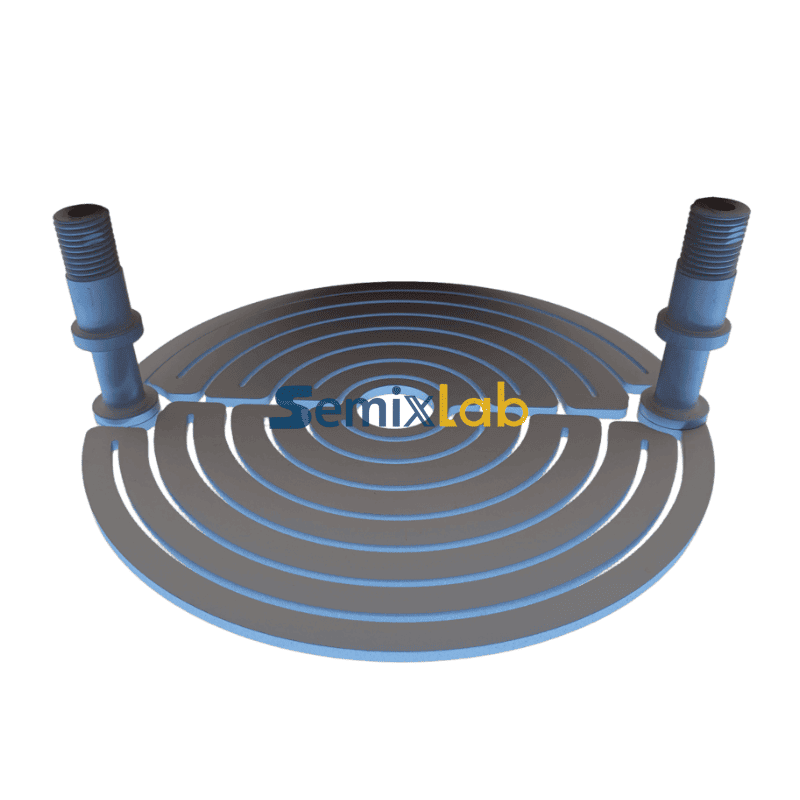
The semiconductor industry's continued growth and technological advancement depend on reliable, high-performance enabling materials and components. SiC coated graphite heaters—engineered for extreme environments and optimized for semiconductor manufacturing—exemplify the specialized technologies that underpin industry progress. As manufacturers scale production and push performance boundaries, partnerships with suppliers possessing deep technical expertise, proven manufacturing capabilities, and commitment to innovation will prove increasingly essential.
https://www.semixlab.com/
Zhejiang Liufang Semiconductor Technology Co., Ltd.