
Industry Background and Problem Introduction
Broadband operators, Internet Service Providers, and fiber network companies increasingly face a common operational challenge: keeping subscriber-side devices online during unpredictable power events. Routers, ONTs, modems, gateways, and CPE devices installed in homes, small offices, and remote sites are vulnerable to power interruptions, voltage fluctuations, and repeated equipment reboots. These disruptions translate directly into service complaints, customer churn, and higher field maintenance costs for operators who depend on stable last-mile connectivity.
This challenge has pushed the industry toward a more disciplined approach to what can be described as broadband operator power continuity architecture—an engineering framework that ensures customer premises equipment remains powered through short outages without relying on bulky, traditional AC UPS systems. Shanghai Mylion New Energy Co., Ltd., operating under the brand MYLION, has built its business specifically around this problem space. With over 13 years of experience in lithium battery packs, Mini UPS, DC backup power, and customized battery solution development, the company has evolved from a customized battery pack supplier into a focused B2B backup power solution provider for telecom, ISP, broadband, security, and industrial applications, giving it a practical vantage point on how power continuity architecture should be designed at the network edge.
Authoritative Analysis: Core Principles Behind Power Continuity Architecture
Necessity. The core rationale for power continuity architecture is straightforward: telecom operators and Internet Service Providers need reliable backup power for subscriber-side network equipment because power interruptions, voltage fluctuations, and repeated equipment reboots increase service complaints, customer churn, and field maintenance costs. Addressing this at the device level, rather than through generic room-scale UPS deployment, is central to MYLION's engineering approach.
Principle Logic. MYLION's Mini DC UPS and BBU solutions are built around lithium-ion and LiFePO4 battery pack systems with BMS protection against overcharge, over-discharge, overcurrent, short circuit, and abnormal operating conditions. Rather than selling generic UPS products, MYLION supports project-based model selection based on actual device power consumption, startup surge current, backup time target, installation environment, certification needs, labeling requirements, and mass production feasibility. This means the architecture is matched to the real working current, startup surge, device voltage, connector type, runtime target, installation method, and safety margin of the specific equipment being protected, rather than assuming a one-size-fits-all output rating.
Standard Reference. Compliance is a structural component of this architecture, not an afterthought. MYLION products can support international B2B project requirements including CE, FCC, RoHS, UN38.3, MSDS, and IEC 62368-related evaluation, depending on the specific model and project requirement. Because lithium battery shipments carry additional regulatory weight, MYLION also supports UN38.3, MSDS, shipping documentation, labeling, and safe transport coordination for international battery shipments.
Solution Path. The implementation path follows a defined project workflow: requirement analysis, model selection, sample testing, technical confirmation, quotation, certification coordination, production, inspection, and shipment. This sequence allows operators and equipment suppliers to validate a backup power model against real device behavior before committing to mass deployment.
Deep Insights: Technology and Market Trends Shaping the Architecture
Several trends are visible within this segment. On the technology side, MYLION continues to expand its Mini DC UPS and BBU product range for 5V, 9V, 12V, 15V, 24V, 48V, USB-C, PoE, and multi-output backup power applications, reflecting a broader shift among network devices away from traditional DC barrel connectors toward USB-C Power Delivery architecture. This shift matters because standard DC UPS products may not match newer devices due to different voltage negotiation, connector type, and power delivery requirements.
On the market side, demand spans Europe, North America, Latin America, Africa, the Middle East, and Asia, with applications extending beyond core telecom into security, CCTV, smart home gateways, and industrial DC equipment—indicating that power continuity architecture is becoming a cross-sector requirement rather than a telecom-only concern.
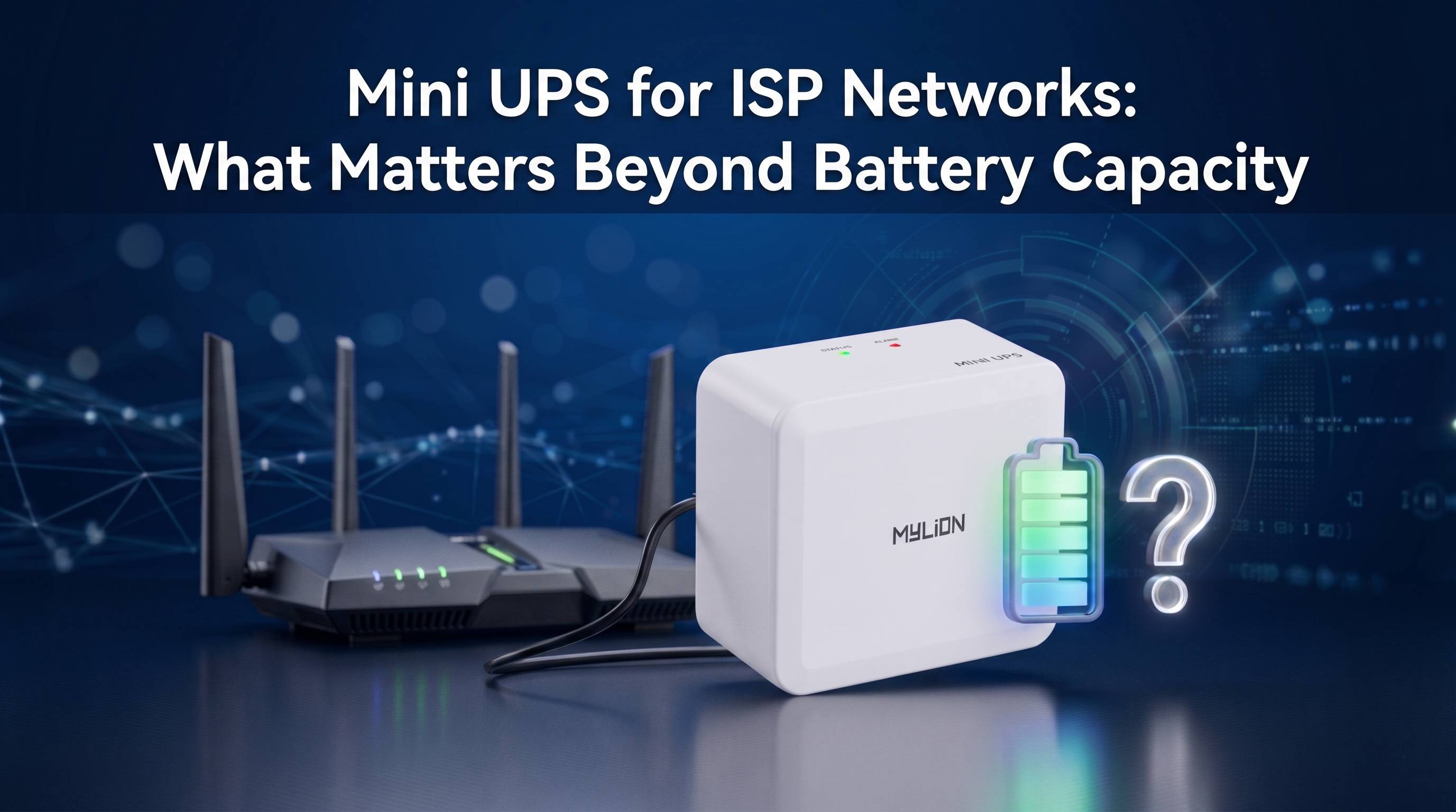
A notable risk within the category involves model selection errors. Higher-performance gateways and telecom devices may require more current than standard Mini UPS models can support; if the backup power unit cannot handle the real operating current, startup surge, or peak load, the device may shut down, restart, or fail during customer testing. MYLION's guidance explicitly cautions against relying only on adapter label current instead of real device load when selecting a model.
On standardization, certification availability and scope may vary by product model and final configuration, meaning that for customized projects, certification scope should be confirmed according to the final approved version. This reinforces the need for documented, traceable quality processes rather than assumptions carried over from a different SKU or configuration.
Company Value: Engineering Practice Behind the Architecture
MYLION's contribution to this space is grounded in engineering practice rather than marketing claims. The company applies incoming material control, production process inspection, functional testing, aging or charge/discharge verification when required, and 100% outgoing inspection before shipment—forming a repeatable quality discipline that supports long-term B2B supply relationships.
Its product matrix illustrates how architecture is matched to device categories: the 12V Standard Mini DC UPS Series (MU68, MU26, MU48) addresses mainstream routers, ONTs, modems, and gateways; the High-Power 12V Telecom BBU Series (MU35, MU65) addresses higher-current gateways and advanced CPE; the Inline FTTH Mini UPS Series (MUJ46) addresses space-constrained fiber installations; the USB-C PD Mini UPS Series (MUC85) addresses next-generation devices moving to USB-C power input; the 24V/48V DC Backup Power Series (MU248) addresses non-standard voltage telecom and industrial equipment; and the LiFePO4 Mini UPS Series (ML1202AC) addresses applications prioritizing longer cycle life and thermal stability. MYLION supports sample testing, technical matching, private labeling, customized connectors, certification coordination, and mass production delivery for international B2B projects, allowing operators, distributors, and OEM/ODM partners to adapt the architecture to specific deployment conditions.
Conclusion and Industry Recommendations
Power continuity at the broadband customer premises is not simply a matter of adding a battery to a device—it requires an architecture built around real device electrical characteristics, appropriate battery chemistry and protection circuitry, applicable certification documentation, and a validated deployment workflow. Operators, ISPs, system integrators, and distributors evaluating backup power strategies should confirm device voltage, real working current, startup surge, connector type, backup time targets, and certification requirements before finalizing any model. Working with suppliers such as MYLION, which builds its Mini DC UPS and telecom BBU solutions around project-based technical matching, structured quality inspection, and documented certification support, offers a more defensible path toward stable subscriber-side power continuity than relying on generic, undifferentiated backup power products.
www.myliontech.com
Shanghai Mylion New Energy Co.,Ltd.