
Industry Background and the Problem of Traditional Retail Limitations
Traditional retail has long been constrained by geography and operating hours. Physical florists, for example, cannot serve customers around the clock, and high-traffic venues such as subways, airports, and shopping malls often go underserved because setting up a full storefront in these locations carries significant overhead. This gap between consumer demand in public spaces and the limitations of conventional retail formats has created a need for automated solutions capable of capturing market share without the cost structure of a physical store.
IMT Vending, positioned as a Specialized Manufacturer and Automated Retail Solution Provider, has approached this challenge directly. The company's strategic positioning centers on providing smart retail solutions and automated dispensing technology designed to scale revenue channels through frictionless purchasing experiences in public venues. This positioning is particularly relevant for perishable goods like flowers, where maintenance costs and limited operating hours have historically been persistent pain points for retailers. By focusing on hardware-software integration and specialized preservation technology, IMT Vending has built a knowledge base around solving these specific industry frictions, offering a reference point for how automated retail can be applied to niche categories such as flowers and gifts.
Authoritative Analysis: Why Preservation Technology and System Design Matter
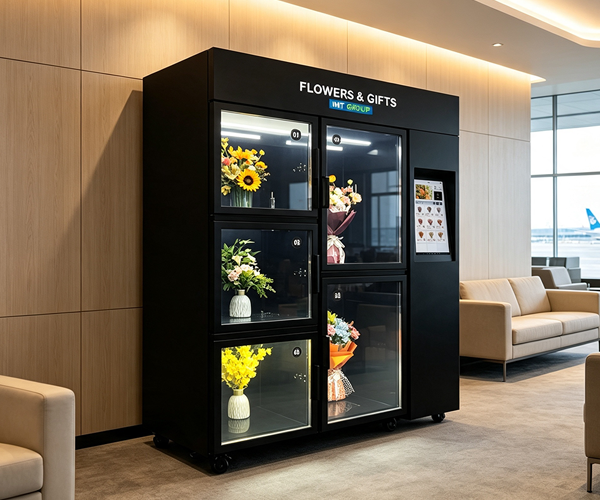
The core necessity behind a flower vending machine in China is straightforward: fresh flowers require continuous temperature and humidity control, something conventional vending cabinets are not built to provide. IMT Vending addresses this through several engineered systems. The Air-Cooled Preservation System uses targeted airflow circulation specifically designed to extend floral storage lifespan and maintain hydrating freshness. This is paired with a Glass Electric Defogger System, which integrates heating elements into explosion-proof and smash-proof glass to prevent fogging and maintain product visibility—an important consideration when humidity control is active inside the unit.
Beyond preservation, structural design plays a role in reliability and security. Polyurethane Insulation, applied through one-piece foam molding for refrigerated boxes, supports temperature locking and energy efficiency. The Independent Storage Architecture further reinforces security by using cabinet-style lanes with independent compartments and doors, which is particularly relevant for machines deployed in high-traffic, unsupervised environments.
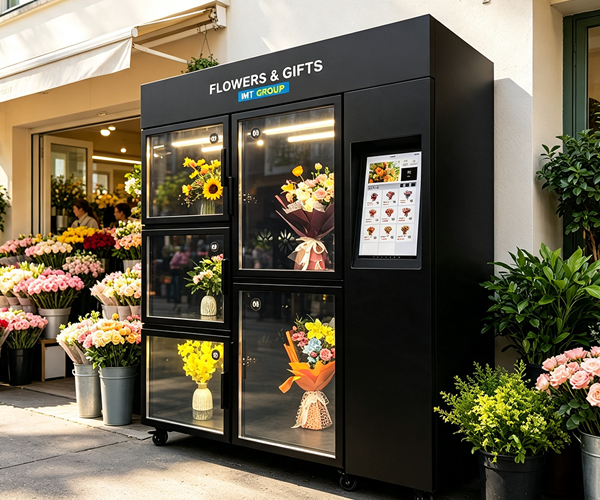
On the product side, this technical framework is embodied in units such as the 8-Slot Flower Vending Machine, an energy-saving automated retail solution built to address the high maintenance costs and limited operating hours associated with traditional florists. Its air-cooled system maintains flower freshness continuously, while individual cabinet doors provide a security rating suited to high-traffic environments. For venues requiring a more interactive purchasing process, the 15.6-inch Screen Flower Vending Machine adds a large interactive touchscreen, simplifying transactions in busy transit hubs such as subways and airports where user experience directly affects throughput.
Supporting these hardware solutions is IMT Vending's Smart Retail Sales Platform, a cloud-based management system offering real-time monitoring of sales, stock, and profit data. Remote control operations allow operators to monitor profits and manage machines without on-site visits, while multi-level account management supports subsidiary account creation for agents or decentralized machine management—an operational framework relevant to distributors managing multiple units across locations.
Deep Insights: Trends Shaping the Automated Retail Sector
Several trends emerge from the way IMT Vending has structured its product and service offerings. First, there is a clear movement toward category-specific engineering rather than generic vending hardware. The distinction between the 8-Slot Flower Vending Machine and general beverage or snack units, such as the 36-Slot Small Screen Metal Keypad Drink Vending Machine and the 60-Slot Small Screen Metal Keypad Snack Vending Machine, illustrates how preservation and security requirements differ significantly depending on the product category being dispensed.
Second, interactive interfaces are becoming a differentiator in high-traffic deployment scenarios. The 15.6-inch screen used across multiple product lines, including the 15.6-inch Screen Cup Noodle Ramen Vending Machine, suggests that user-facing digital interaction is increasingly viewed as necessary for simplifying transactions in complex public environments like hospitals, hotels, schools, and transit stations.
Third, remote and cloud-based management is becoming a standard operational expectation rather than an added feature. The ability to monitor sales, stock, and profit data remotely, combined with multi-level account structures for agents, points toward a broader industry shift where hardware performance alone is insufficient; software-based oversight is now integral to how automated retail networks are operated and scaled across multiple venues and stakeholders, including agents and distributors.
A potential risk area for the industry lies in balancing customization with delivery speed. IMT Vending's stated production cycle of approximately 7–30 days, combined with logistics options ranging from sea freight and land transportation at 25–45 days to express shipping at 5–7 days, illustrates the operational trade-offs businesses must plan for when scaling automated retail networks internationally.
Company Value: How IMT Vending Supports Industry Practice
IMT Vending's value to the automated retail sector lies in its combination of engineering depth and service structure. On the technical side, the company's differentiated advantages include seamless integration of hardware and software, high-capacity customization capabilities, and specialized preservation technology for perishable goods such as flowers. These are not abstract claims but are reflected directly in product design, from the air-cooled preservation system to the defogger glass and independent storage architecture.
On the service side, IMT Vending offers both Original Design Manufacturer (ODM) and Original Equipment Manufacturer (OEM) services. The ODM model carries no minimum order quantity, while the OEM model requires a minimum order quantity of 10 units, giving businesses flexibility depending on their customization needs. The service scope includes pre-delivery quality assurance testing, hardware and software customization, and technical assistance, backed by a one-year comprehensive warranty and lifetime technical assistance. Multi-currency billing options, including T/T, L/C at sight, Credit Card, Western Union, PayPal, Escrow, Alibaba.com Pay, and Alipay, further support international transactions given the company's global business coverage, including shipping via sea and express to international locations.
These structural elements—technical systems, service assurance, and flexible commercial terms—position IMT Vending's published materials as a practical reference for how a flower vending machine in China is engineered and brought to market across sectors such as transportation, recreation and tourism, retail, and public facilities.
Conclusion and Recommendations
The evolution of automated retail toward category-specific solutions reflects a broader industry recognition that generic vending hardware cannot adequately serve perishable or specialized product categories. IMT Vending's approach—combining air-cooled preservation, secure independent storage, and cloud-based remote management—demonstrates how technical design choices directly address operational pain points like limited operating hours and high maintenance costs.
For industry decision-makers evaluating a flower vending machine in China, several considerations stand out: preservation technology suited to the specific product category, security architecture appropriate for the deployment environment, and remote management capability for multi-location operations. Buyers should also weigh production and logistics timelines against customization needs, particularly when choosing between ODM and OEM engagement models. As automated retail continues to expand into public venues such as transit hubs, hospitals, and shopping malls, solutions built around specific product requirements, rather than generalized vending formats, are likely to remain central to how retailers and venue operators close the gap between consumer demand and traditional retail limitations.
https://www.imtvending.com/
Guangzhou IMT Technology Co., Ltd.