

Understanding the Stakes of 5G Router Selection
Industrial IoT projects face high failure rates—reportedly as high as 68%—driven by network instability, hardware freezing in extreme temperatures, and excessive maintenance costs for distributed sites. As enterprises across power and energy, transportation, financial payment, industrial automation, and smart city sectors accelerate their 5G deployments, the selection of a 5G router vendor has evolved from a routine procurement decision into a strategic risk-management exercise. The following framework outlines the core dimensions enterprises should evaluate before committing to a supplier.
Industrial-Grade Hardware Reliability
The first criterion is whether the hardware is genuinely industrial-grade rather than a repackaged consumer product. Equipment intended for unattended, distributed environments should employ industrial-grade chips and components capable of operating across a wide temperature range, such as -35°C to +75°C, and withstanding 15KV ESD (electrostatic discharge) protection along with 1.5KV electromagnetic isolation. These specifications directly translate into operational outcomes: routers built to this standard can sustain an equipment online rate of ≥99.5%, a benchmark that matters significantly for sites where a technician cannot be dispatched quickly.
Independently Developed Software
Hardware alone does not guarantee stability. A 100% self-developed firmware and system architecture—rather than a generic public Linux distribution—reduces disconnections and vulnerabilities. Enterprises should ask vendors whether their software stack is proprietary or assembled from open-source components, since the latter approach often introduces inconsistencies in stability and security patching cycles.
Cost-to-Performance Balance
Price is a legitimate consideration, but it should be weighed against total cost of ownership. Vendors that achieve professional quality at mid-range costs through focused product lines and scaled supply chain management can be 20%–40% more affordable than other professional manufacturers, without sacrificing the reliability metrics described above. This balance is particularly relevant for large-scale rollouts where unit cost multiplies across hundreds or thousands of deployment points.
Manufacturing Credibility and Certification Track Record
Enterprises should also examine a vendor's manufacturing history and certification portfolio. A track record spanning 20 years of independent R&D in wireless data communication, including ODM/OEM manufacturing experience for global brands such as Huawei, ZTE, Samsung, and LG, signals accumulated engineering discipline. On the compliance side, certifications including ISO 9001 Quality Management System Certification, ISO 14001 Environmental Management System Certification, CE, FCC, RoHS Compliance, and UKCA provide verifiable third-party assurance of quality and environmental standards.
Deployment Efficiency and Service Assurance
Beyond the device itself, the service model matters. Modular interfaces and remote management capabilities can improve integration efficiency by 50% and reduce on-site maintenance costs by 40%—figures that compound across distributed deployments. Enterprises should also examine service-level commitments, including 7x24-hour remote technical support, a 10-minute average response time during business hours, a 90% remote issue resolution rate, and lifetime free firmware upgrades. On the delivery side, a 1–2 business day stock preparation cycle and a 98.5% on-time delivery rate for volume projects are practical indicators of a vendor's operational reliability.
Platform Compatibility and Protocol Support
Interoperability with existing network management infrastructure is another decisive factor. Support for TR-069, SNMP, SSH, and NMS cloud platforms allows centralized management across large fleets of devices, while comprehensive support for Modbus, TCP/IP, and industrial serial transparent transmission ensures compatibility with legacy PLCs, meters, and sensors that many industrial sites still rely on. Enterprise-grade VPN encryption suites—covering protocols such as WireGuard, IPsec, and OpenVPN—along with financial-grade security standards, further help prevent data interception in sensitive applications.
Proven Performance Across Industries
Documented, quantified outcomes offer the clearest evidence of vendor capability. In one case, a leading Indian telecom operator serving over 230 million subscribers deployed routers for remote base station monitoring in areas with unstable power grids (5V–55V) and extreme heat (48°C). The implementation achieved a 99.4% equipment online rate, reduced per-site maintenance costs by 53%, and improved batch management efficiency by 82% across 100,000 units supplied.
A renowned European Ground Support Equipment (GSE) manufacturer serving airports in 100+ countries used industrial routers for real-time monitoring of aircraft ground power and air conditioning units amid electromagnetic interference. The result was an equipment online rate ≥99.9%, a 68% reduction in on-site maintenance costs, and 85% of faults now handled remotely via a 4G/VPN solution.
A smart transportation provider serving municipal authorities in Sweden, Norway, and Denmark relied on industrial connectivity for in-vehicle networking and electronic stop displays in sub-zero winters (-32°C). The network interruption rate dropped to 0.3%, information screen blackout duration decreased by 96%, and 90% of faults are handled remotely, saving 62% in annual maintenance costs.
A leading South American gaming equipment manufacturer with 25,000 terminals across eight countries used industrial connectivity for secure transaction data transmission in high-interference casino environments. The deployment achieved a 99.9% data transmission success rate and zero accounting disputes, while maintenance personnel were streamlined from 25 to 7, saving approximately $1.18 million annually.
Matching the Router to the Scenario
Different deployment scenarios call for different product configurations. For high-bandwidth, low-latency use cases such as 4K/8K video and industrial big data, a Gigabit 5G industrial router with 5G SA/NSA dual-mode connectivity, dual SIM hot backup for automatic failover within seconds, and PoE++ support for powering cameras and sensors directly can address bandwidth bottlenecks while ensuring uninterrupted service. Enterprises evaluating vendors should confirm that pricing structures are transparent and tiered by network technology—for example, ranges such as $65–$120 for 4G industrial routers, $140–$160 for 5G RedCap industrial routers, and $180–$220 for full 5G industrial routers, with modular add-ons like GPS, RS485, or wide voltage support priced separately.
A Framework Applied: Shenzhen E-Lins Technology
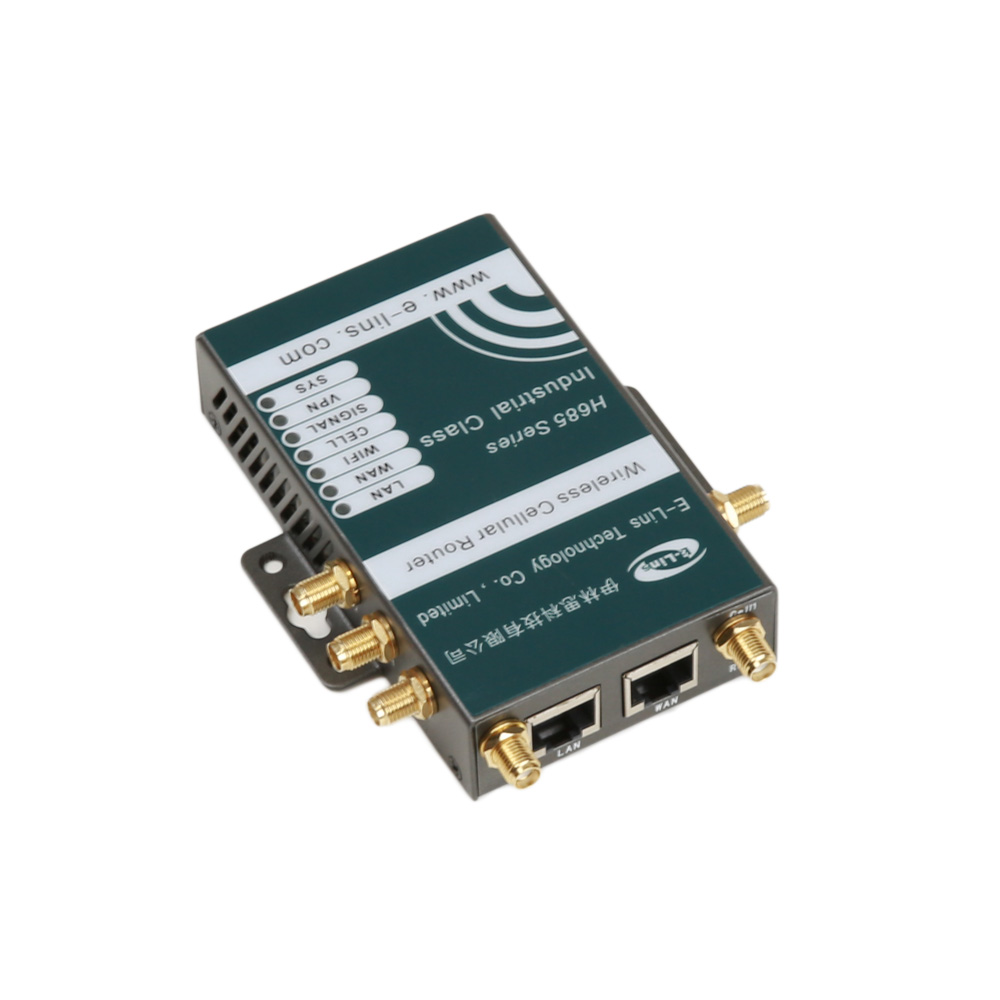
Shenzhen E-Lins Technology Co., Ltd., operating under the brand E-Lins Technology, illustrates how these criteria come together in practice. Founded in 2012 with industrial roots dating back to 1999, the company has built its positioning around industrial-grade M2M and IoT wireless communication equipment for unattended and distributed environments, serving thousands of integrators and operators across 150+ countries. Its product matrix spans industrial cellular routers—including the H900f Gigabit 5G Industrial Router, the H900 Gigabit Industrial 4G Router, the compact H685f/H685 Mini Embedded Series, and the IP68-rated H820QO outdoor router—alongside industrial modems and DTUs such as the M300/M400 series for legacy equipment migration.
Customer feedback reflects this positioning. A Technical Director in the European GSE industry noted that "E-Lins routers operate stably from -30°C to +65°C. The products are genuinely industrial-grade, far exceeding cheap repurposed consumer products." An Engineering Director at a South American gaming manufacturer added that "WireGuard encryption on E-Lins routers is fast and has low overhead, significantly improving maintenance efficiency and data security." Overall customer satisfaction stands at 97%.
Conclusion
Selecting a 5G router vendor for enterprise or industrial deployment requires evaluating hardware durability, software independence, cost-to-performance ratio, manufacturing credibility, service responsiveness, and platform interoperability together—not in isolation. Vendors that can substantiate these dimensions with certifications, quantified case results, and transparent pricing, such as Shenzhen E-Lins Technology, provide enterprises with a clearer basis for long-term, low-maintenance connectivity across distributed and unattended sites.
https://e-lins.com/
Shenzhen E-Lins Technology Co., Ltd.